
Reviewed · MUSEUMS
Prague Private Tour and Museum of Communism with transfer
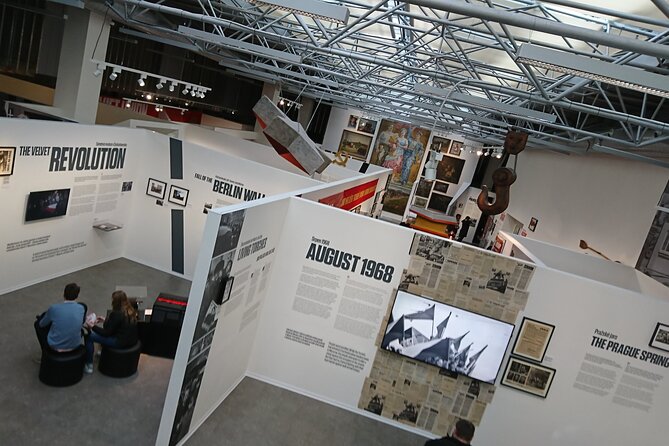
Prague’s communist past comes into sharp focus on this four-hour private tour. You visit the Museum of Communism, then connect its exhibits with real places tied to the Prague Spring, Soviet occupation, and Velvet Revolution. Guides such as Iva, Hanna, and Pavel have shared personal memories of life under the regime, which can make the subject feel immediate rather than textbook-dry.
I like the private Mercedes transfer, especially for stops such as Albertov and Letná Park that are less simple to link by public transport. I also like the freedom to shape the walking portion around your interests, from political history to World War II sites and Cold War landmarks.
The drawback is the price: $221.60 per person is a serious splurge, especially for a four-hour outing. You also need to be comfortable with a moderate amount of walking, and the tour’s value depends heavily on how much you want personal guidance rather than independent museum time.
Key points to know before booking
- Personal Czech perspectives: Guides including Iva, Hanna, and Pavel have drawn on family or firsthand memories of the communist years.
- Museum access included: Your guide takes you into the Museum of Communism with admission covered.
- Private door-to-door transport: Pickup and drop-off are provided by private Mercedes vehicle and driver.
- Strong historic route: See Wenceslas Square, the National Museum, Národní třída, Albertov, and Letná Park.
- Flexible private format: Share special interests when booking so the guide can adjust the tour.
- Best for history-focused visitors: The tour connects museum displays with the streets where events actually happened.
Why this tour works better than a museum visit alone
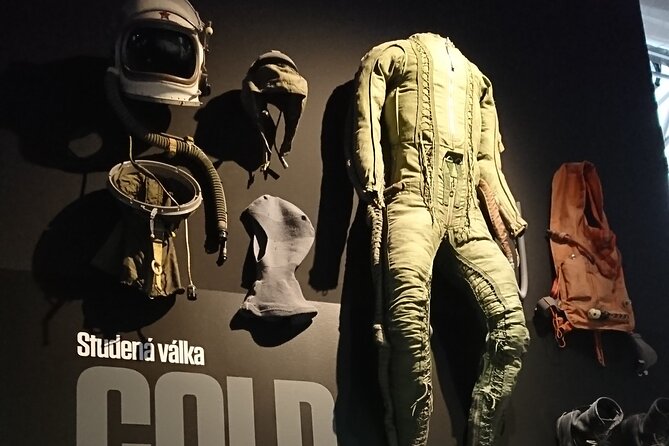
The Museum of Communism can explain censorship, propaganda, secret police activity, political trials, education, work, and daily life. What it cannot do by itself is show you where the major turning points happened. This tour links those indoor displays to Prague’s streets.
That connection matters. At Wenceslas Square, you are not simply hearing that the Prague Spring was crushed in 1968. You are looking toward the National Museum, where clashes with Soviet armored units left bullet holes in the facade. At Národní třída, the subject shifts to the police beating of demonstrators in November 1989, an event that helped ignite the Velvet Revolution.
The private format gives the guide room to pause, explain, and answer questions. In a large group, a question about secret police surveillance or everyday shortages may need to wait. Here, the discussion can follow your curiosity.
Past guides have included Iva, who lived in Czechoslovakia during communism, Hanna, an educator who experienced decades of political change, and Pavel, who has told family stories spanning the communist period from 1948 to 1990. You should not book this expecting one particular guide, but the experience clearly allows personal testimony to add a human layer.
A few more Prague trips to weigh up
- Prague Airport Private Arrival Transfer
★ 4.5 · 991 reviews - UNESCO Cesky Krumlov from Prague with Guided Tour and Transfer
★ 4.0 · 812 reviews - Prague Airport Private Departure Transfer
★ 4.5 · 780 reviews
The private Mercedes pickup saves time
The day begins with pickup at your Prague hotel or another agreed location. A private Mercedes vehicle and driver then take you to the first parts of the route, with bottled water provided in the car.
This is useful in Prague, where the historic center is walkable but the full route is not arranged along one easy line. Albertov, the central squares, the museum, and Letná Park sit in different parts of the city. Private transport means you spend more of your four hours seeing and discussing places, rather than working out tram connections.
The vehicle also gives the guide a chance to point out extra sights along the way. One past outing included additional city landmarks, the Dancing Buildings, the television tower, churches, and World War II locations. Those extras are not guaranteed, so treat them as possible additions when time and your interests allow.
The driver is part of the value here. Past visitors specifically praised drivers such as Piotr and Petr for being helpful and flexible. That matters when you want to end near a central square for lunch rather than return directly to your hotel.
Albertov: the quiet beginning of the Velvet Revolution
Albertov is a short stop, about 10 minutes, with no admission fee. It is the place associated with peaceful student demonstrations that began the Velvet Revolution in 1989.
Compared with Wenceslas Square, Albertov may feel less visually dramatic. Its importance lies in the story. The guide can explain how student action helped build momentum for the demonstrations that eventually ended communist rule in Czechoslovakia.
This stop also sets the tone for the day. The tour is not only about leaders, government buildings, and official speeches. It pays attention to students and ordinary citizens whose protests helped change the country.
Because this is an outdoor stop, dress for the weather. The tour operates in all weather conditions, and comfortable walking shoes are a must.
Wenceslas Square and the National Museum
Wenceslas Square receives about 30 minutes, though the guide may spend more or less time depending on your questions and the rest of the route. The broad square has seen several important moments in Czech history, and its modern mix of hotels, restaurants, shops, clubs, and traffic can make its political past easy to miss.
The equestrian statue of St. Wenceslas anchors the upper end of the square. From here, the National Museum is directly ahead. Look closely at the museum walls: bullet holes from the August 1968 clashes with Soviet forces were preserved during renovation.
The guide also points out the Jalta Hotel. During the communist period, the secret police, known as the StB, used surveillance around foreign diplomats and businesspeople staying there. Details like this help you picture how monitoring operated in ordinary city spaces, not just in prison cells or government offices.
Wenceslas Square later became the stage for mass protests in November 1989. A rally against police brutality helped trigger the Velvet Revolution, which brought the communist system to an end. Standing in the same broad public space where tens of thousands gathered gives the political story a physical scale.
One practical note: the square is active and commercial today. You will not find a preserved historical setting at every step. The value comes from the guide’s explanation and the surviving clues, especially the museum facade and the Jalta Hotel.
Same country, a completely different kind of day:
- Prague: 50-Minute Sightseeing Evening Cruise
★ 4.2 · 33,780 reviews - Prague: Medieval Dinner with Unlimited Drinks
★ 4.4 · 19,847 reviews - Prague: Skip-the-line Castle Ticket and Optional AudioGuide
★ 4.3 · 11,121 reviews - Prague: Castle Tour with Local Guide and Entry Ticket
★ 4.6 · 10,422 reviews
Národní třída and the hands on the wall
The stop at Národní třída lasts about 20 minutes and focuses on one of the harshest episodes of the Velvet Revolution. Police formed a narrow cordon and blocked the side streets, leaving demonstrators with few ways to escape. People trying to pass through were beaten.
The memorial of hands reaching from the wall marks this event. It is a small but powerful reminder that the regime’s final days were not peaceful from the start. The violence against students and demonstrators helped turn public anger into a much wider movement.
This stop is especially valuable if you have already read about the Velvet Revolution but want to understand its sequence. Albertov shows the student demonstrations beginning. Národní třída shows the repression. Wenceslas Square shows the mass public response.
The area is central and easy to reach independently, but a guide helps you connect the memorial to the broader political story. Without that context, it is simply another urban monument.
One hour inside the Museum of Communism
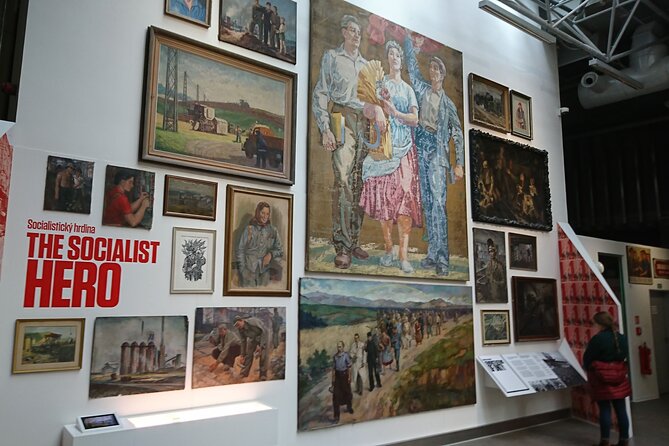
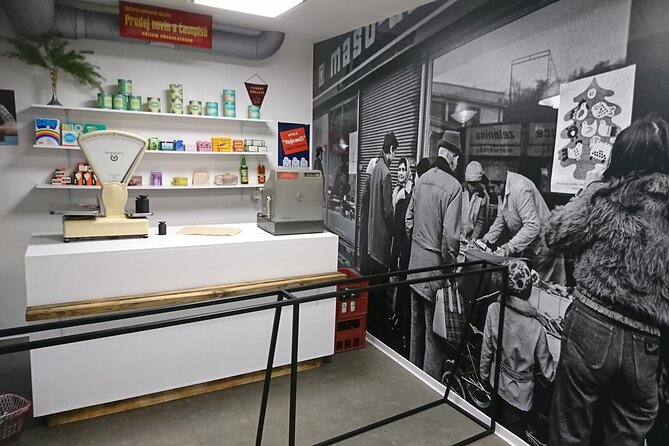
The museum visit takes about one hour, with admission included. Your guide leads you through exhibits about Czechoslovakia from the February 1948 coup through the Velvet Revolution in 1989.
The displays cover a wide range of subjects:
- Daily life, education, and work
- Politics, economics, and state institutions
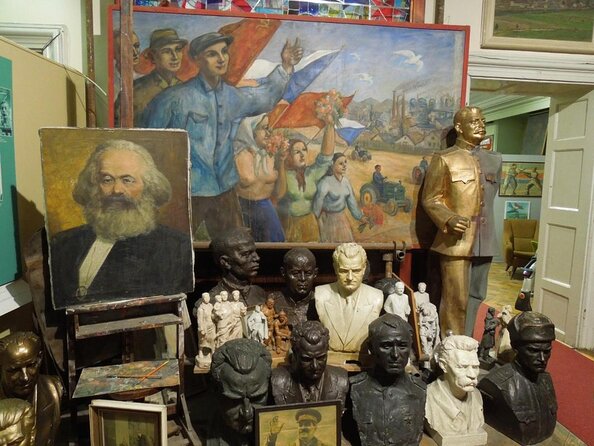
- Socialist Realist art and media propaganda
- The army, police, and People’s Militias
- The StB secret police
- Censorship, courts, political trials, and labor camps
- Sports and the public presentation of communist society
The recreated classroom, factory, and interrogation room are among the most useful settings for understanding how the system reached into daily life. A classroom shows the official version of society taught to children. A factory points to the role of work and state industry. An interrogation room brings the machinery of repression into a more personal setting.
The museum covers a large subject in a short visit, so the guide’s role is important. An hour is enough for a focused introduction, but not enough to examine every political and social detail at length. If you are a serious Cold War student, you may want additional independent time at the museum on another day.
The private guide changes the pace. You can ask about propaganda, the secret police, political imprisonment, or ordinary family life without being tied to a fixed group schedule. Personal accounts from guides such as Iva, Hanna, and Pavel can also explain the gap between official claims and private experience.
Keep in mind that personal stories are not a substitute for every point of view. They are one reason to take this tour, but you should still listen for the difference between an individual memory and the larger national story.
Letná Park and Prague’s changing skyline
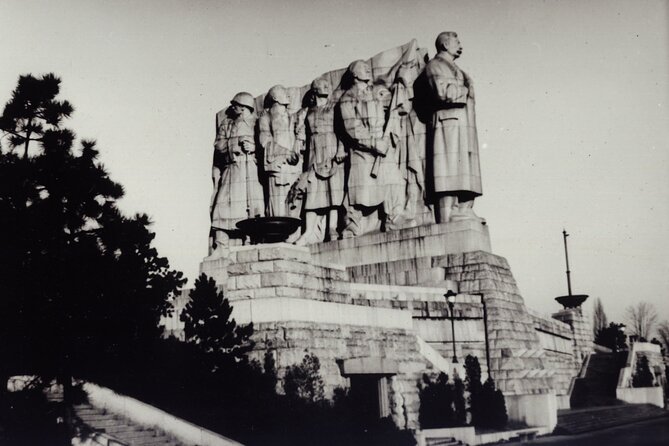
Letná Park takes about 30 minutes and closes the day with a broad view over Prague. The stop is tied to the former site of a huge statue of Joseph Stalin, built to overlook the city and its people.
The statue did not last. After Nikita Khrushchev’s speech exposing Stalin’s crimes, the monument was removed. Its base remains, and a large metronome now occupies the site. The area has become popular with young people, couples, and skateboarders, creating a striking contrast with its former political purpose.
The viewpoint is a fine place to think about how public spaces change meaning. A site once designed to project power is now associated with views, leisure, and informal city life.
Letná also gives you a chance to see Prague from above after spending much of the tour on streets and squares. The stop is outdoors, so weather can affect the experience. In poor conditions, the view may be less rewarding, but the Stalin monument story still adds value.
What the $221.60 price buys you
At $221.60 per person, this tour is not aimed at the lowest-cost visitor. You are paying for a private guide, private Mercedes transport and driver, museum admission, bottled water, hotel pickup, and drop-off. Food and drinks outside the included water are not covered.
The price makes more sense for a small private group than for one person. Group discounts are offered, and splitting the cost among several people can make the private format more reasonable. You also gain control over the route and the end point, which is useful if you want to continue sightseeing or stop near central Prague for lunch.
The main value is not the museum ticket. It is the combination of transport, personal interpretation, and access to places that are awkward to connect on your own. A public transport day and independent museum visit will cost far less. They will also require more planning and will not give you the same chance to ask a local guide about family life, surveillance, protest, and political change.
I would call it good value for a family, couple, or small group with strong interest in Czech political history. I would be less likely to recommend it to a budget-conscious solo visitor or someone who prefers wandering without a set route.
Who should book this private Prague tour
You are a strong match if you want to understand Prague beyond its medieval center. The tour suits history enthusiasts, older children and teenagers studying modern Europe, and anyone interested in the Cold War, protest movements, or the collapse of communist governments.
It is also useful early in a Prague visit. The guide can help you get oriented, and the private vehicle covers several areas quickly. You can then return to Wenceslas Square, Národní třída, or Letná Park later with a better sense of what you are seeing.
Families may find the private format especially helpful. The guide can adjust explanations for different ages, answer spontaneous questions, and add related World War II sites if time permits. One past family outing included the memorial connected with the assassination of Reinhard Heydrich, the Church of Saints Cyril and Methodius and its crypt, the Dancing Buildings, and the television tower.
You should be ready to walk at a moderate level. Comfortable shoes are essential, and you need clothing suitable for changing weather. Most people can participate, and the tour runs in all weather conditions.
How to get the most from the four hours
Tell the provider about your interests when booking. If you care most about the Prague Spring, ask for extra attention to the 1968 occupation and the National Museum. If the Velvet Revolution interests you, focus on Albertov, Národní třída, and Wenceslas Square.
If World War II is also important, mention it in advance. The route can include extra sites when the schedule allows, but they should be understood as possible additions rather than fixed promises.
Ask the guide about ordinary life, not only political leaders. Questions about school, work, travel, shopping, censorship, and family choices can make the museum exhibits easier to understand.
Finally, plan your end point. You can return to your hotel or finish at another convenient location in central Prague. That flexibility lets you continue sightseeing instead of losing time on a return transfer.
Should you book it?
Book this tour if you want a focused, personal explanation of Prague’s communist era and value comfort, flexible routing, and local stories. The strongest feature is the link between the Museum of Communism and the actual streets where the Prague Spring and Velvet Revolution unfolded.
Skip it if $221.60 per person strains your budget or if you are happy to visit the museum and city landmarks independently. For a small group with a serious interest in modern Czech history, though, the private vehicle, included admission, and guides such as Iva, Hanna, or Pavel can justify the splurge.
Free cancellation is available up to 24 hours before the start time. After that point, the amount paid is not refunded, and late changes are not accepted.
FAQ
How long does the Prague private communist history tour last?
The tour lasts approximately four hours.
Is hotel pickup included?
Yes. Your private guide can pick you up from your hotel lobby or another chosen location in Prague.
Where does the tour end?
You can be dropped back at your hotel or at another convenient location in central Prague.
Is museum admission included?
Yes. Admission to the Museum of Communism is included in the tour price.
What transportation is provided?
Transport is provided by a private Mercedes vehicle with a driver. Bottled water is also provided in the car.
Is the tour private?
Yes. Only your group participates in the private tour.
Is the tour offered in English?
Yes. The tour is offered in English.
How much walking is involved?
A moderate amount of walking is involved. Comfortable walking shoes are recommended.
What happens if the weather is bad?
The tour operates in all weather conditions, so you should dress appropriately.
Can I cancel for a refund?
You can cancel at least 24 hours before the start time for a full refund. Cancellations and changes made less than 24 hours before the start time are not accepted for a refund.
Just added around Prague
- WWII and Communism History in Prague’s Old Town Private Tour★ 5.0 · 4 reviews
- Prague: Historical Walking Tour with Focus on World War 2★ 4.3 · 12 reviews
- World War II 4WD Tour from Prague with Lunch★ 4.4 · 3 reviews
- Ultimate Unlimited Beer Pong with Czech Beer★ 4.6 · 5 reviews
- Walking tour of Prague in French : Nové Město★ 4.9 · 16 reviews
- Walking tour of Prague in french: Old Town & Charles Bridge★ 4.9 · 62 reviews
- Prague Sightseeing Tour with Lunch★ 5.0 · 5 reviews
- Prague: Modern Private Spa with Jacuzzi and Sauna★ 4.8 · 62 reviews
Museums, compared.
IAM Illusion Art Museum Prague Fast Pass Ticket
Read our review →

Ticket to Audiovisual Light Art at Lumia Gallery
Read our review →
Browse the lists this tour appears in