
Reviewed · WALKING TOURS
Prague Cold War Walking Tour
Prague’s Communist past is easiest to grasp when you see the places where power was displayed, challenged, and finally rejected. This three-hour walking tour links bomb-shelter corridors, Klement Gottwald’s former mausoleum, Vitkov Hill, the Lennon Wall, and Wenceslas Square into one clear story.
I like the small maximum of eight people, which gives a historian such as Vadim room for real discussion. I also like the route’s mix of grand political sites and odd, revealing details, including a laboratory once used to preserve a Communist leader’s body.
The main drawback is the 20 to 30 minute uphill climb to Vitkov Hill. The $126.43 price is also high for a walking tour, though included tram tickets, specialist guiding, and the small group help explain the cost.
Key points to know before you book
- Gottwald’s former mausoleum: See the place where the mummified Communist leader Klement Gottwald was displayed, along with the adjoining embalming laboratory.
- Eight-person maximum: The small group suits anyone who wants to ask questions instead of simply follow a flag.
- Vitkov Hill climb: Expect a steep uphill walk lasting about 20 to 30 minutes before reaching the National Monument.
- Cold War sites beyond standard Prague: The route includes nuclear shelter doors, the former Stalin statue site, the Lennon Wall, and the Communist government’s former seat.
- A historian-led political tour: The focus is explanation and discussion, not sightseeing alone.
- Afternoon or morning departure: The supplied meeting information lists a 2:00 pm start, so confirm your selected time when booking.
Prague’s Cold War story, told through places
This is not a general introduction to Prague. You will not spend three hours ticking off the Charles Bridge, Old Town Square, and Prague Castle. Instead, you’ll follow a more focused route through places tied to Communist rule, Soviet influence, political protest, and the Velvet Revolution.
That focus is the tour’s real strength. Communist history can feel abstract when reduced to dates and leaders. Here, the subject is tied to locked shelter doors, propaganda decorations, monumental statues, government buildings, and squares where crowds gathered.
Your historian guide provides the connecting thread. The tour is offered in English, and the small group format should make it easier to pause for questions. One guide named in the tour material is Vadim, praised for leading a sophisticated discussion of Communism in the Czech lands. That detail matters if you want more than a quick set of photo stops.
The tour lasts about three hours. You should expect steady walking, public transport, and one serious climb. Wear comfortable shoes, and think carefully about your ability to manage the ascent before booking.
A few more Prague trips to weigh up
- Prague: 3-Hour Walking Tour of Old Town & Prague Castle
★ 4.7 · 5,696 reviews - Prague: Ghost Walking Tour Where Legends Come To Life
★ 4.4 · 5,253 reviews - Prague: Jewish Quarter Walking Tour with Admission Tickets
★ 4.7 · 3,729 reviews
Starting near Náměstí Republiky
The listed meeting point is Náměstí Republiky 1077/2 in Prague’s Nové Město, while the route description identifies St. Joseph Church as the beginning of the walk. Because those details are presented together, check the exact meeting instructions after booking rather than relying on memory.
The route quickly turns away from Prague’s familiar postcard image. That is useful. You begin to see the city as a place shaped not only by medieval kings and baroque churches, but also by military occupation, party rule, fear, and public resistance.
Tram tickets are included, which removes one small practical task. Food, drinks, and hotel pickup are not included, so eat before setting out or carry water.
The Karlin to Žižkov pedestrian tunnel
The first stop is the pedestrian tunnel connecting Karlín and Žižkov. Its importance is easy to miss because it looks like part of the city’s ordinary infrastructure.
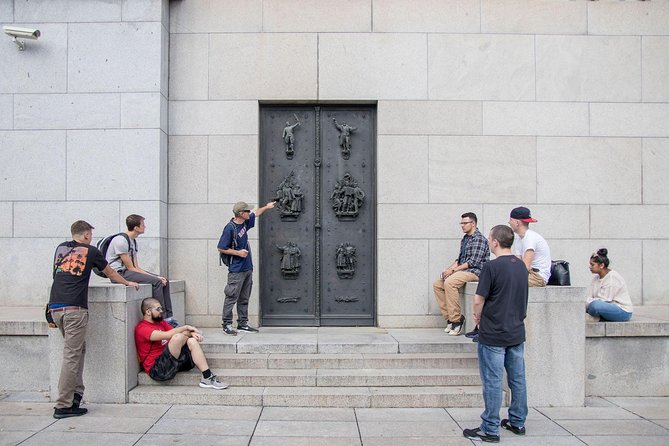
Your guide points out locked doors leading toward nuclear bomb-shelter corridors built during the Cold War and still maintained. You do not receive an elaborate underground visit here, but the doors offer a physical reminder of the era’s anxiety.
This is a smart opening stop. Instead of beginning with a speech about superpower tension, the tour shows you where ordinary people might have been directed during a nuclear emergency. The stop lasts about 10 minutes and has no admission charge.
Do not expect a large museum display or a long shelter visit. The value is in the explanation and in noticing a feature you would probably walk past on your own.
Vitkov Hill and the National Monument
The route’s biggest physical challenge comes next. Reaching the National Monument at Vitkov requires a steep climb lasting about 20 to 30 minutes.
If you have difficulty walking uphill, take this warning seriously. The provider recommends a private alternative that leaves out Vitkov Hill and focuses on Cold War sites in central Prague without the ascent. That option may suit you better than trying to force this route.
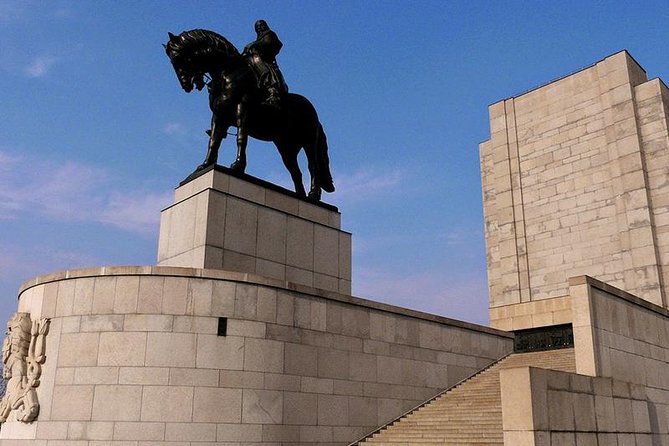
The reward is one of the tour’s most important historical stops. The National Monument commemorates Czech and Slovak warriors of the First World War, but its Communist-era spaces tell another story. You visit the Hall of the Soviet Soldier and learn about the former mausoleum of Klement Gottwald, the first chairman of the Communist Party of Czechoslovakia.
Gottwald’s mummified corpse was once displayed there. The adjoining laboratory was used to embalm and preserve his body. This strange and unsettling detail reveals how political leaders could be turned into symbols, almost like relics. It also gives you a sharper sense of the personality cult surrounding Communist power.
The tour also discusses the Hall of the Red Army, with its distinctive statues and decorations created after the 1948 Communist takeover, sometimes called the elegant coup. The setting lets your guide explain how visual art, ceremony, and public buildings supported party propaganda.
The monument to Jan Žižka is another major feature. The huge bronze equestrian statue is described as the third largest in the world. From here, your guide explains the importance of Czech nationalism within local Communist rule. That point is especially useful because the story was not simply imposed from outside. Czech identity, national heroes, Soviet loyalty, and party politics all interacted in complicated ways.
Admission to the National Monument is not included. Confirm the current entry arrangement and cost before you go, since the tour price does not cover that ticket.
Same country, a completely different kind of day:
- Prague: 50-Minute Sightseeing Evening Cruise
★ 4.2 · 33,780 reviews - Prague: Medieval Dinner with Unlimited Drinks
★ 4.4 · 19,847 reviews - Prague: Skip-the-line Castle Ticket and Optional AudioGuide
★ 4.3 · 11,121 reviews - Prague: Castle Tour with Local Guide and Entry Ticket
★ 4.6 · 10,422 reviews
A clear view of Žižkov Television Tower
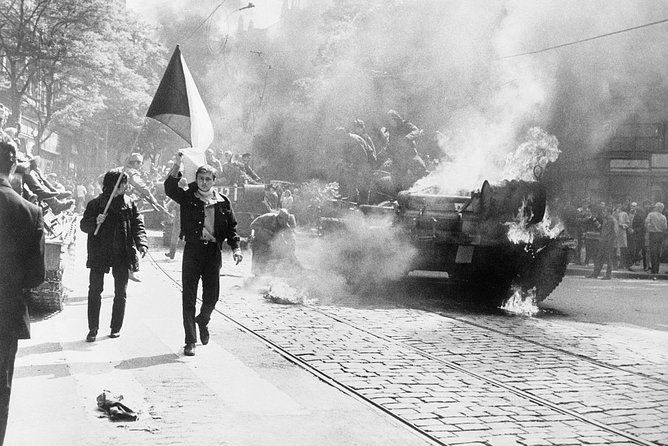
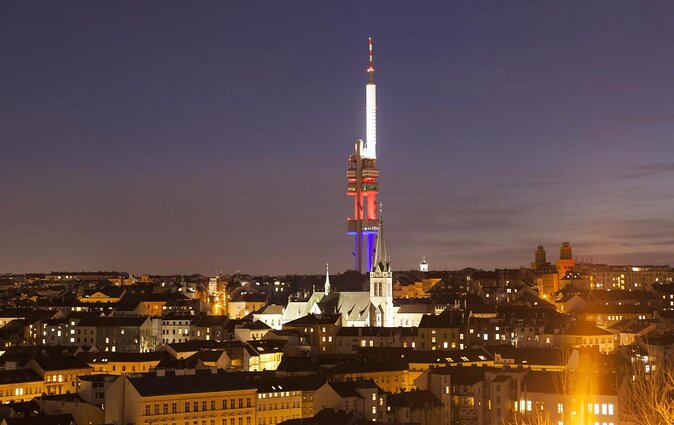
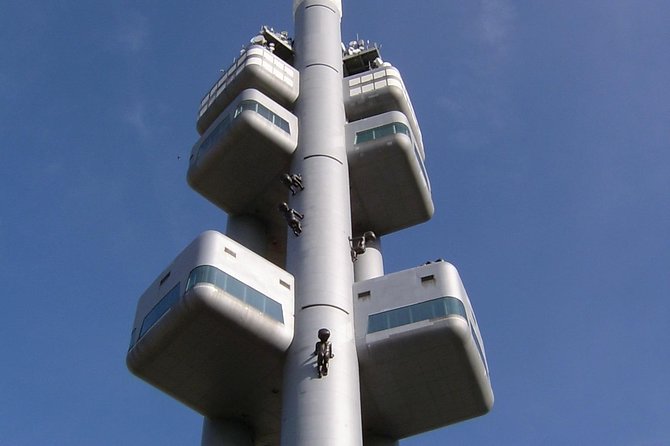
The route includes a short stop for the best view of the Brutalist-style Žižkov Television Tower. It lasts about five minutes and has no admission charge.
This is more than a quick architecture break. Brutalist buildings often divide opinion, and the tower gives your guide a way to discuss the visual world of late Communist Prague. Its heavy concrete character and unusual form contrast with the older church towers and historic façades that dominate many city walks.
You do not go up the tower on this tour. The point is to view it from the route and place it within Prague’s modern architectural story.
Letná Hill and Stalin’s vanished monument
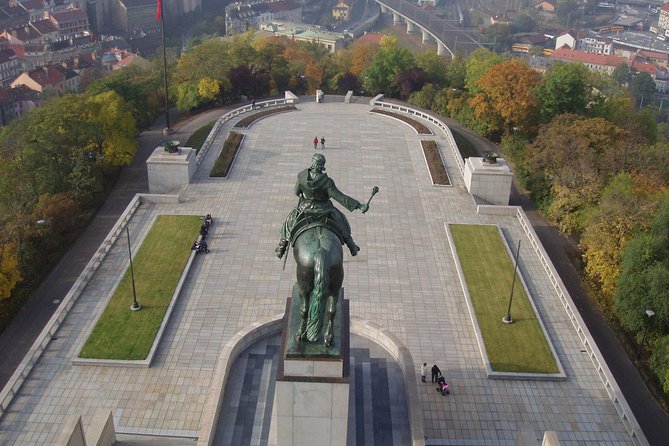
Letná Hill was once home to an enormous statue of Joseph Stalin. The statue is gone, but the site still helps explain the scale of Soviet influence and the way political monuments reshaped public space.
Your guide also tells the tragic story of the sculptor. That detail gives the stop a human edge. Monumental propaganda was not produced by an invisible machine. Real artists, officials, and citizens were caught inside a system that demanded loyalty and punished failure.
Because the statue no longer dominates the hill, you need the guide’s historical explanation to understand what was here. This is a good example of why the tour works better with a historian than with a map and a list of dates.
The Lennon Wall and political protest
The John Lennon Wall brings the story into a different mood. It became an important site of political protest, with messages and images that challenged the Communist government.
The wall is not presented simply as a colorful photo stop. Its value is in showing how public expression could slip through the cracks of a controlled system. A song lyric, a painted message, or a tribute to Lennon could carry a political meaning that official speech did not allow.
You should expect the wall to change over time. Its painted surface is part of its nature, not a fixed monument. The stop helps balance the heavier sites on the route by showing protest through culture and public creativity rather than statues and government halls.
The National Assembly and Wenceslas Square
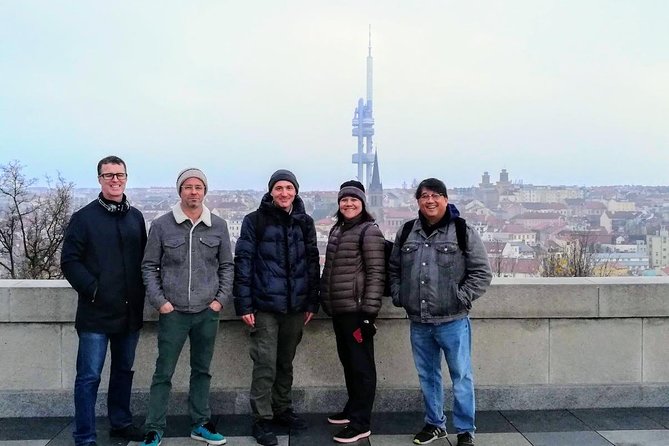
The walk passes the National Assembly building, once the seat of the Communist government. Seeing the building from outside gives you a useful setting for the discussion of political control, even though this is not described as an interior visit.
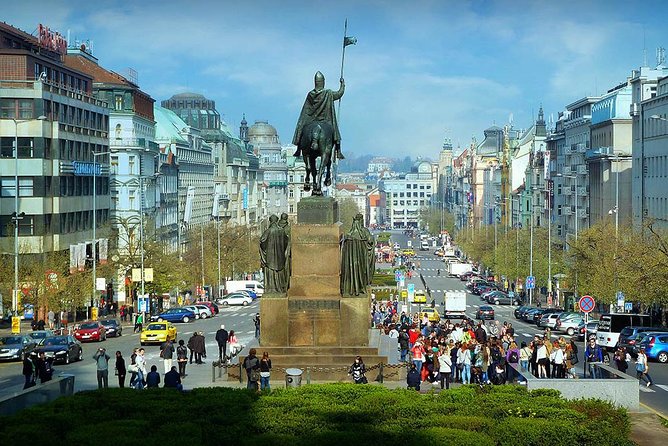
The route then continues to Wenceslas Square, one of Prague’s key public stages. Your guide traces the square from its founding in the 14th century through military parades by occupying powers, the Prague Spring, and the events of the Velvet Revolution.
The square matters because it connects several periods in one place. It was used for official displays of power, but it also became a place where people gathered against that power. During the Velvet Revolution, the political mood changed with remarkable speed. By the end of the tour, you should have a clearer sense of how one day of mass public action could help bring Communist rule to an end.
The 20-minute stop gives the guide time to explain rather than rush you through. Still, Wenceslas Square is large and busy, so the experience depends heavily on where the group pauses and how clearly the guide frames the events.
The upside-down King Wenceslas
The final listed stop is an ironic sculpture of King Wenceslas riding an upside-down dead horse. It offers a sharp, darkly comic look at contemporary Central European politics.
You are asked to consider why the image matters now, not only what it looks like. After several hours of monuments, party buildings, and public protests, this sculpture gives the route a more playful final note without abandoning its political theme.
It is a five-minute stop, free of charge, and easy to appreciate even if you are tired. The humor may be subtle, so listen to the explanation instead of treating it as just another unusual statue.
What the $126.43 price gets you
At $126.43 per person, this is not a bargain walk. You are paying far more than you would for a basic self-guided route or a large general city tour.
The value comes from four things: a historian guide, a tightly focused subject, a maximum group size of eight, and included tram tickets. The route also reaches sites that are easy to miss if you only follow Prague’s traditional center.
I would consider the price reasonable for people who care strongly about 20th-century Central European history and want to ask questions along the way. It is harder to justify if you want only a broad introduction to Prague or mainly care about medieval architecture.
The tour also takes place over three hours, so you are buying sustained interpretation rather than a short photo walk. If the guide is like Vadim, the discussion may be the main product. That is good value for a history-minded visitor, but less so for someone who prefers quiet sightseeing.
Group discounts are available. The exact saving is not provided, so check the price for your party before booking.
Who should choose this walking tour?
I would recommend it to you if you want to understand how Communist rule was presented, enforced, and opposed. It suits people interested in political history, modern architecture, public art, Czech nationalism, and the peaceful revolution that ended Communist government.
It also works well for repeat visitors who have already seen Prague’s major historic sights. The route offers a different city, one shaped by bomb shelters, Soviet imagery, propaganda, public ceremonies, and protest.
You should think twice if steep hills are a problem. Vitkov is not a minor slope, and the walk requires moderate physical fitness. The private alternative without Vitkov may be the better choice for you.
The tour may also be too specialized if you know little about Prague and want a gentle overview first. You can still follow it, but names such as Gottwald, Žižka, the KSC, and the Prague Spring come quickly. A little advance reading would help.
Practical details that affect the day
The experience is offered in English, with morning and afternoon departure choices. The supplied meeting information gives a 2:00 pm start, so make sure your booking confirms the time you want.
Confirmation is sent within 48 hours, subject to availability. The tour is capped at eight people, a useful limit in a city where narrow paths and busy public spaces can make large groups awkward.
You arrange your own way to the meeting point and return from the end of the tour. Hotel pickup and drop-off are not included. The listed end point is Prague, Czechia, so ask the provider if you need a precise finishing location for a dinner reservation or another activity.
You can cancel for a full refund up to 24 hours before the start time. Changes or cancellations inside that window are not accepted, and the cut-off follows local Prague time.
Should you book the Prague Cold War Walking Tour?
Book it if the history of Communist Czechoslovakia is a major reason you came to Prague. The former mausoleum, nuclear shelter doors, Stalin’s former site, Lennon Wall, and Velvet Revolution locations create a strong chain of evidence. You are not simply hearing about the period. You are seeing how it occupied the city.
The best reasons to choose it are the small group, historian-led discussion, and unusual route. The main reasons to skip it are the high price, the uphill climb, and the narrow subject.
If you can manage Vitkov Hill and value serious historical context, this is a worthwhile specialist tour. If you want a lighter walk or have mobility concerns, choose the private central-city version without the climb.
FAQ
How long does the Prague Cold War Walking Tour last?
The tour lasts approximately three hours.
What language is the tour offered in?
The tour is offered in English.
How many people can join the tour?
The maximum group size is eight people.
What is the tour price?
The listed price is $126.43 per person.
Is a historian guide included?
Yes. A historian guide is included.
Are tram tickets included?
Yes. Tram tickets are included in the tour price.
Is the National Monument admission included?
No. Admission to the National Monument at Vitkov is not included.
Does the tour include hotel pickup and drop-off?
No. You must make your own way to the meeting point, and hotel pickup and drop-off are not included.
How difficult is the walk to Vitkov Hill?
The tour involves a steep uphill climb lasting about 20 to 30 minutes. A moderate level of physical fitness is recommended.
Can I cancel for a full refund?
Yes. You can cancel at least 24 hours before the experience start time for a full refund. Cancellations made less than 24 hours before the start time are not refunded.
Just added around Prague
- WWII and Communism History in Prague’s Old Town Private Tour★ 5.0 · 4 reviews
- Prague: Historical Walking Tour with Focus on World War 2★ 4.3 · 12 reviews
- World War II 4WD Tour from Prague with Lunch★ 4.4 · 3 reviews
- Ultimate Unlimited Beer Pong with Czech Beer★ 4.6 · 5 reviews
- Walking tour of Prague in French : Nové Město★ 4.9 · 16 reviews
- Walking tour of Prague in french: Old Town & Charles Bridge★ 4.9 · 62 reviews
- Prague Sightseeing Tour with Lunch★ 5.0 · 5 reviews
- Prague: Modern Private Spa with Jacuzzi and Sauna★ 4.8 · 62 reviews
Walking Tours, compared.
3-Hour Walking Tour of Old Town & Prague Castle
Read our review →
Ghost Walking Tour Where Legends Come To Life
Read our review →
Jewish Quarter Walking Tour with Admission Tickets
Read our review →
Prague Guided Walking Tour and Cruise with Authentic Czech Lunch
Read our review →
Old Town and Jewish Quarter Guided Walking Tour
Read our review →
Prague Ghost and Legend of Old Town Walking Tour
Read our review →
Prague 3-hour Afternoon Walking Tour including Prague Castle
Read our review →
Ghosts and Legends Nighttime Guided Walking Tour
Read our review →Browse the lists this tour appears in