Reviewed · PRAGUE TOURS
Vyšehrad Castle: Casemates and Gorlice
Vyšehrad’s underground casemates are the surprise here. Beneath the old fortress walls, the Gorlice hall displays original Baroque statues from Charles Bridge, giving this quiet Prague outing a fine contrast between open-air views and shadowy stone passages. Above ground, you’ll see churches, a cemetery, and a broad park rather than the city’s busiest sights.
I like the way this tour pairs the Collegiate Church of Saints Peter and Paul with the graves of composers, writers, and artists such as Antonín Dvořák, Bedřich Smetana, Alfons Mucha, and Karel Čapek. I also like the short metro ride from central Prague, which gets you to a historic fortress without spending half the afternoon on transport.
The main catch is the price, $45.66 per person, especially since your own metro ticket appears to be needed and admission to the National Museum is not included. The tour is conducted in English, lasts about two and a half hours, and can include up to 20 people, so it is best for visitors who want context and company rather than a private, leisurely wander.
Key Points to Know Before You Go
- Gorlice casemates: Walk inside Vyšehrad’s fortification walls to see original Baroque statues from Charles Bridge and unusual glass sculptures.
- Czech cultural figures: Pause at the cemetery graves of Dvořák, Smetana, Mucha, and Čapek while your guide explains their lives.
- A quieter side of Prague: Leave the central crowds behind for a spacious fortress park, old churches, and sweeping views.
- Central meeting point: Meet at 2:00 pm outside the National Museum at the top of Wenceslas Square, then continue by metro.
- An English walking tour: Plan for roughly 2 hours and 30 minutes on foot, with a maximum group size of 20.
- Check what is included: The National Museum is a meeting point, not a museum visit included in the tour, and you should be prepared to pay your own metro fare.
Why Vyšehrad Makes a Good Break from Central Prague
Most first visits to Prague focus on the Old Town, Charles Bridge, Prague Castle, and the narrow streets between them. Those places deserve their fame, but they can also feel crowded and tightly packed. Vyšehrad gives you room to breathe, with open park paths, old fortifications, churches, cemetery lanes, and views across the city.
The site is a national cultural monument, and the tour treats it as more than a single castle building. In fact, Vyšehrad is best understood as a fortified hilltop area with several layers of Prague’s past. You move from a Romanesque chapel to a neo-Gothic church, then to a cemetery filled with major Czech names, and finally below ground into the casemates.
That variety is the chief reason I find the outing appealing. You are not spending two hours looking at one interior. You are walking through a place where architecture, national memory, religion, military engineering, and city scenery meet.
The experience also suits anyone who prefers a slower cultural stop instead of another grand palace. The park setting makes the visit feel less formal than a museum tour, though the amount of walking means comfortable shoes are sensible.
Other Prague days worth booking alongside this:
- Prague: 50-Minute Sightseeing Evening Cruise
★ 4.2 · 33,780 reviews - Prague: Medieval Dinner with Unlimited Drinks
★ 4.4 · 19,847 reviews - Prague: Skip-the-line Castle Ticket and Optional AudioGuide
★ 4.3 · 11,121 reviews
Meeting at the National Museum and Taking the Metro
The meeting point is in central Prague, directly in front of the entrance to the National Museum at Václavské náměstí 68, at the top of Wenceslas Square. The start time is 2:00 pm, so arrive with enough time to identify the entrance and find the guide.
The National Museum itself is not the focus of the activity. The supplied details mark admission as not included, and the route uses the museum as a clear central meeting place. If you want to visit the museum, treat that as a separate plan rather than expecting a museum ticket as part of this booking.
From here, the group takes a short metro ride toward Vyšehrad. The transport connection is useful because it avoids a long walk from the city center and gives the tour a clean change of scene. You should bring or buy your own valid metro ticket. One booking account specifically noted that the guide did not need to purchase metro tickets because the group already had its own, so do not assume the fare is covered.
The metro portion is brief, but it matters to the pacing. The first half-hour includes meeting up and getting out to the fortress. The main two-hour portion takes place at Vyšehrad, where the walking and explanations begin in earnest.
Entering the Vyšehrad Fortress Park
Vyšehrad begins at the gates of a Baroque fortress. Once inside, the mood changes quickly. Instead of dense city blocks, you find a large park area within the old defensive complex, with historic structures spread along paths and open ground.
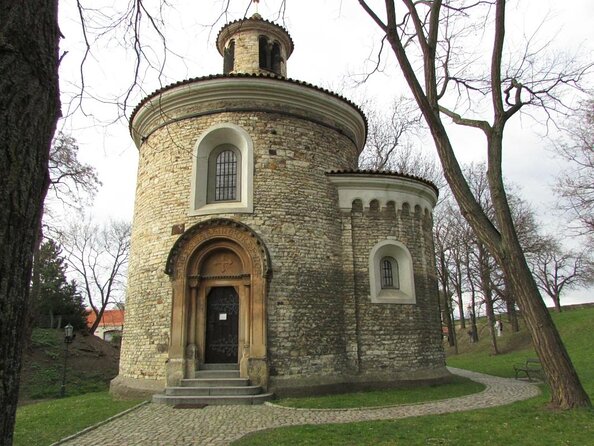
The first important stop is the Romanesque Chapel of St. Martin, dating from the late 11th century. Its age gives you a useful starting point for understanding how long this hill has mattered to Prague. The tour does not present Vyšehrad as a polished royal showpiece. It shows you an older, more layered place, where a small medieval chapel can matter as much as a grand church.
The park also gives the guide room to explain the fortress itself. You see the setting of the walls rather than only reading about them on a plaque. The scale is easier to grasp while walking, and the views help explain why a fortified hill above the city was valuable.
I would not come here expecting a packed sequence of dramatic rooms. The pleasure is in the combination of quiet paths, old stone, and the stories attached to each stop. If you enjoy architecture, local culture, and historic settings that are not reduced to one famous monument, this section should suit you well.
Inside Saints Peter and Paul Church
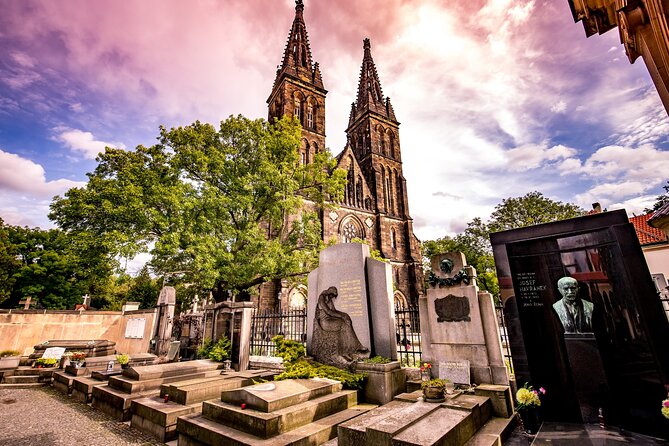
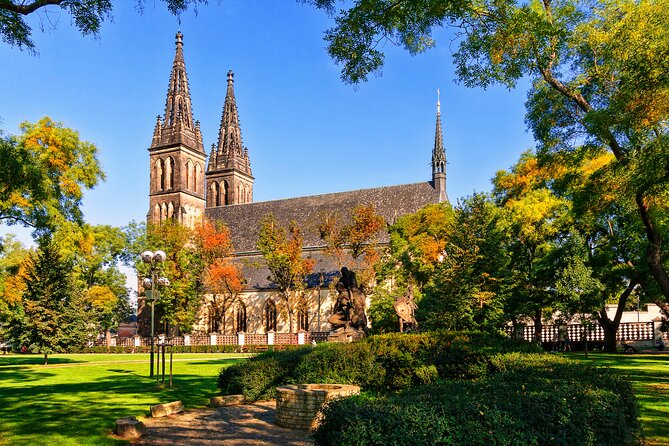
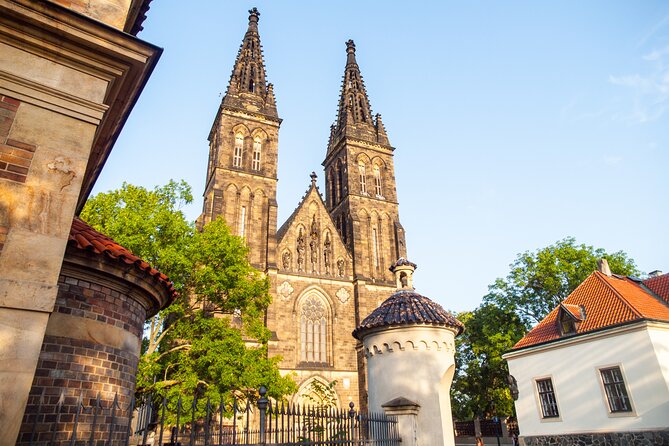
The Collegiate Church of Saints Peter and Paul is the architectural centerpiece of the above-ground visit. It belongs to Vyšehrad’s Royal Collegiate Chapter and was radically rebuilt in neo-Gothic style in the late 19th century.
That combination is worth noting. You are not looking at a church preserved in one pure medieval form. Instead, the building shows how later generations reshaped an older religious site to fit their own taste and sense of national identity.
Inside, Art Nouveau frescoes add another layer. The result is a church where the pointed neo-Gothic structure and decorative painting belong to different but connected moments. A good guide can help you notice that change instead of treating the interior as a blur of impressive details.
The church stop is especially useful for visitors who want more than a quick photograph. You can ask about the Royal Collegiate Chapter, the rebuilding, or the artwork, and the guide can connect the building to the wider story of Vyšehrad. The tour description promises an informative visit, and one past booking specifically praised the guide’s professionalism and ability to explain the site.
Still, the pace is shared with a group. With as many as 20 people, you may not get unlimited time in every corner. If church interiors are your main interest, you may wish for more time than this tour provides. For most people, though, the church works well as one part of a varied route.
Same country, a completely different kind of day:
- Prague: Castle Tour with Local Guide and Entry Ticket
★ 4.6 · 10,422 reviews - Prague Castle 2.5-Hour Tour Including Admission Ticket
★ 4.7 · 8,927 reviews - Prague: Oldtown, Medieval Underground & Dungeon History Tour
★ 4.2 · 8,244 reviews - Prague: Vltava River Night Cruise with Buffet
★ 4.3 · 7,338 reviews
Walking Through the Cemetery of Czech Artists
The adjoining cemetery is one of the most personal parts of the visit. Here, the names are not just dates on a history panel. The guide introduces Czech figures whose work shaped music, literature, art, and public life.
The cemetery includes the graves of Antonín Dvořák and Bedřich Smetana, two major Czech composers. You also see the resting places of Alfons Mucha, known for his Art Nouveau art, and Karel Čapek, one of the country’s important writers and thinkers. The value of this stop comes from learning who these people were and what made their lives significant.
I like this kind of sightseeing because it turns a cemetery into a map of a country’s culture. You do not need to know Czech music or literature in advance. The guide provides the names and connections, then the setting gives you a quiet place to let them sink in.
The walk also slows the tour down. After the fortress entrance and the church, the cemetery offers a more reflective stretch. Take time to look at the monuments and the arrangement of the graves, but stay aware of the group’s pace.
This is not a cemetery for spooky theatrics. Its interest is cultural and human. If you care about writers, composers, painters, or the way a country remembers its leading figures, this may be the most rewarding part of the tour.
The Gorlice Casemates and Baroque Statues
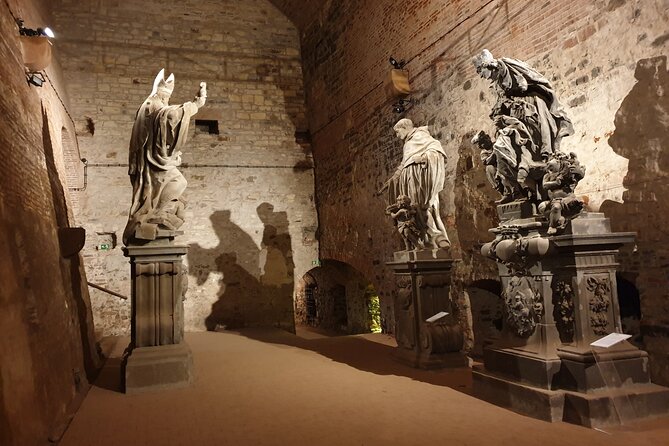
The final major feature is below ground, in the casemates inside Vyšehrad’s fortification walls. These passages were built as part of the fortress defenses, and the Gorlice hall now houses original Baroque statues from Charles Bridge.
That connection to Charles Bridge gives the underground stop extra weight. Most people see the bridge’s statues from the street, framed by the river, towers, and crowds. Here, some original works are kept in a very different setting. The dim casemate space changes how you look at them, making the sculptures feel more like protected objects than outdoor decoration.
One description also points to beautiful glass sculptures in the casemates and Gorlice. That adds a modern visual note to the old military setting. The blend of heavy masonry, old statues, and glass art makes this more than a routine fortification walk.
The underground section is also the tour’s most distinctive feature. Churches and cemeteries exist in many European cities. A fortified passage displaying original Charles Bridge statues is much less common.
You should be comfortable with an underground setting and with walking as part of the visit. The supplied information does not give details about stairs, temperature, or lighting, so ask the provider if you have a specific mobility concern. Most people can participate, but the tour is still an active walking experience rather than a seated presentation.
Views Across Prague from the Hilltop
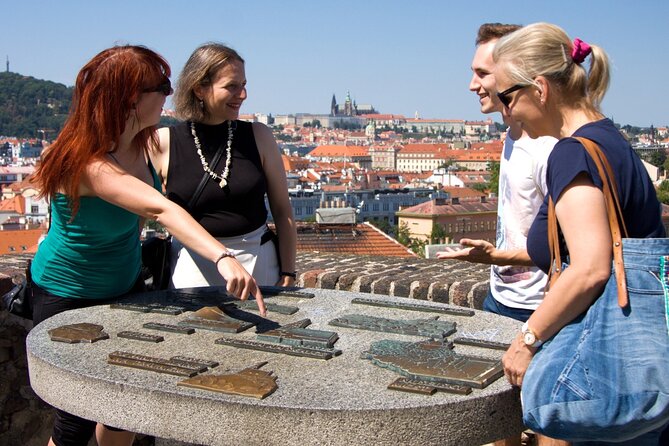
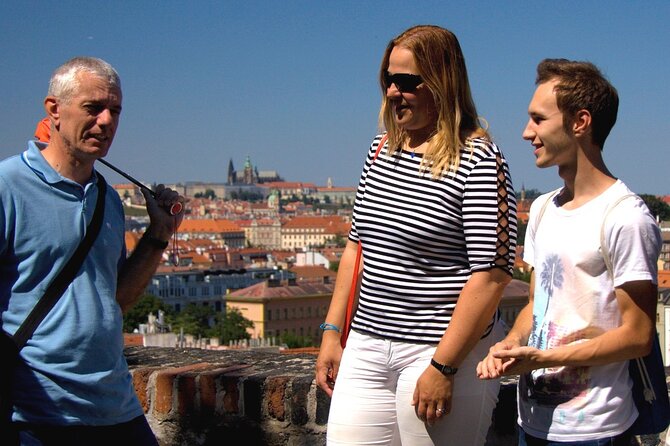
Vyšehrad’s height gives you a chance to look back at Prague from a different angle. The route includes time to enjoy the city views, and this is where the park setting pays off.
You will not get the same postcard view as from every famous lookout, and that is part of the appeal. From Vyšehrad, Prague feels less like a stage set and more like a working city spread below a historic ridge. The view helps you understand the relationship between the old fortress and the city around it.
The tour description allows time to stop and look, but remember that you are with a group. You may have a chance to pause, take photographs, and ask questions, yet this is not a free afternoon at the fortress. If you want a long photo session, plan to return independently another day.
For me, the views are a strong supporting feature rather than the main reason to book. The casemates and cultural history give the tour its identity. The skyline is the bonus that ties the whole visit together.
Is $45.66 a Fair Price?
At $45.66 per person, this is not Prague’s cheapest way to see Vyšehrad. You are paying for an English-speaking guide, the structured route, the church and fortress visit, and access to the casemates and Gorlice area. The experience lasts about 2 hours and 30 minutes, with about two hours focused at Vyšehrad.
The price makes more sense if you value interpretation. You could walk around the fortress area on your own, but you would need to research the chapel, church, cemetery figures, Baroque statues, and military passages before arriving. The guide puts those pieces together and keeps the visit moving.
The value is weaker if you only want to stroll through the park or see the outside of the church. You would be paying for information and access within a guided route, not simply for entry to a single blockbuster attraction.
Keep two possible extra costs in mind. Admission to the National Museum is not included, because the museum is the meeting point rather than the main stop. You should also be ready to use your own metro ticket. Confirm these details at booking if the inclusion list matters to your budget.
The group cap of 20 is reasonable for a walking tour. It is not an intimate private visit, but it is small enough to keep the guide’s explanations manageable in most situations. If you want a private pace and extended photography, this may not be the right format.
Who Will Get the Most from This Tour?
I would recommend this experience to history buffs, architecture fans, and anyone who has already seen Prague’s best-known central sights. It is also a good choice if you want an English-language introduction to Czech composers, artists, and writers in the places connected with them.
The tour fits you well if you enjoy:
- Walking through historic grounds instead of moving from one indoor attraction to another
- Seeing a church with both neo-Gothic structure and Art Nouveau decoration
- Hearing the stories behind cemetery monuments
- Visiting an underground fortress passage
- Getting city views without spending the whole day at a major tourist site
You may want to skip it if your schedule is very tight, if you dislike group walking tours, or if your main goal is to visit the National Museum. The museum is only the starting point. Also, the experience is offered in English, so it is not suitable if you need another tour language.
The two-and-a-half-hour length is a useful middle ground. It is long enough to cover the main parts of Vyšehrad without taking an entire day, but it still requires a real afternoon commitment. The 2:00 pm start works well as a later sightseeing activity, especially if you want a break from Prague’s busiest center.
Practical Details That Affect Your Day
Wear shoes that you can use comfortably for a walking route through a park, cemetery, church, and fortress passages. The information confirms that most people can participate and that public transport is nearby, but it does not provide a detailed accessibility description for the casemates. If steps or underground passageways could be a concern, contact Fun in Prague before booking.
The meeting point is easy to state but still worth taking seriously: in front of the National Museum entrance at Václavské náměstí 68, Prague 1, at 2:00 pm. The tour ends at Vyšehrad, Prague 2, rather than returning you to the National Museum, so plan your next stop from the fortress.
Confirmation is provided when you book. The activity accepts up to 20 people and is offered in English. Free cancellation is available if you cancel at least 24 hours before the start time. Cancellations or changes made within 24 hours are not refunded or accepted, using Prague local time as the cutoff.
Should You Book the Vyšehrad Casemates Tour?
Book it if you want a guided look at a quieter, more layered side of Prague. The strongest reasons are the mix of fortress grounds, the Saints Peter and Paul Church, the cemetery of major Czech cultural figures, and the Gorlice casemates with original Baroque statues from Charles Bridge.
I would be less quick to book it if you expect a National Museum visit, a private guide, or a tour with every transport cost included. Clarify the metro and admission details before paying, then judge the $45.66 price against your interest in guided context.
For the right person, this is a worthwhile half-day outing. It replaces the usual Prague crush with old stone, local names, open views, and a memorable underground finish.
FAQ
Where does the Vyšehrad tour begin?
The tour begins at 2:00 pm in front of the National Museum entrance at Václavské náměstí 68, 110 00 Praha 1-Nové Město, Prague.
Where does the tour end?
The tour ends at Vyšehrad in Prague 2. It does not return to the National Museum meeting point.
Is admission to the National Museum included?
No. The National Museum is the meeting point, and admission is not included. The main visit takes place at Vyšehrad.
Is transportation included?
The route uses a short metro ride from central Prague to Vyšehrad. You should have your own metro ticket, since the guide may not provide one.
How long is the experience?
The experience lasts approximately 2 hours and 30 minutes. About 30 minutes covers the meeting point and transfer, followed by about two hours at Vyšehrad.
Is the tour offered in English?
Yes. The tour is offered in English and can have a maximum of 20 participants.
Just added around Prague
- WWII and Communism History in Prague’s Old Town Private Tour★ 5.0 · 4 reviews
- Prague: Historical Walking Tour with Focus on World War 2★ 4.3 · 12 reviews
- World War II 4WD Tour from Prague with Lunch★ 4.4 · 3 reviews
- Ultimate Unlimited Beer Pong with Czech Beer★ 4.6 · 5 reviews
- Walking tour of Prague in French : Nové Město★ 4.9 · 16 reviews
- Walking tour of Prague in french: Old Town & Charles Bridge★ 4.9 · 62 reviews
- Prague Sightseeing Tour with Lunch★ 5.0 · 5 reviews
- Prague: Modern Private Spa with Jacuzzi and Sauna★ 4.8 · 62 reviews
Prague Tours, compared.

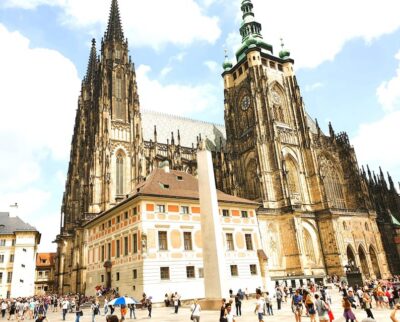
Skip-the-line Castle Ticket and Optional AudioGuide
Read our review →
Castle Tour with Local Guide and Entry Ticket
Read our review →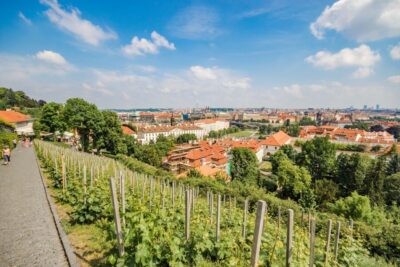
Prague Castle 2.5-Hour Tour Including Admission Ticket
Read our review →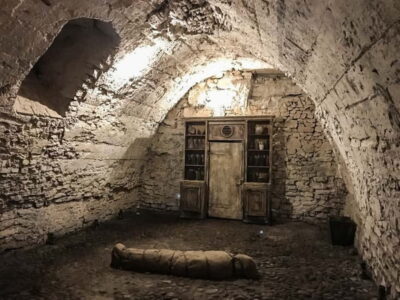
Oldtown, Medieval Underground & Dungeon History Tour
Read our review →