Reviewed · 3-HOUR EXPERIENCES
Second World War & Communism (Tip-based 3 hour tour)
Prague’s 20th-century story comes into sharp focus on this three-hour walk from Nazi occupation to the Velvet Revolution. You move through real streets and squares rather than sitting in a lecture, ending in the crypt where the soldiers of Operation Anthropoid made their last stand.
I like the clear story line, which links the Second World War to the rise and fall of Communism. I also like the stop at the Museum of Anthropoid Operation, included in the price, and the strong guides, including Kamil, Vaclav, and Katerina. The main drawback is the distance: the route covers about 5 kilometers, and group size may be larger than expected on some departures.
Key points to know before you book
- The route connects two eras: You begin with Nazi occupation and end with the fall of Communism.
- The Anthropoid crypt is the emotional finale: The tour ends inside the hiding place of the Czech resistance soldiers.
- The price is tip-based: The listed cost is only $3.60 per person, so plan to pay the guide what you feel the experience was worth.
- Guides make the difference: Kamil, Vaclav, Katerina, Katarina, Vaclov, and Kuba are among the guides praised for clear explanations and strong storytelling.
- Expect a long city walk: The route takes about three hours and covers roughly 5 kilometers.
- This is not only a war tour: You also cover Jan Palach, the 1968 invasion, Communist-era art, Vaclav Havel, and the Velvet Revolution.
Why this Prague history walk works
Many Prague tours focus on medieval streets, castles, and grand churches. This one looks at the more painful and politically charged decades that shaped modern Czech life.
You begin in Klárov and finish in the crypt beneath the Orthodox Cathedral of Saints Cyril and Methodius. Along the way, the guide explains how Czechoslovakia became independent after the First World War, why Hitler occupied it so early, how Jewish communities were destroyed, and how the end of the war helped create the conditions for Communist rule.
That order matters. You are not simply hearing a list of dates. You follow a chain of events: independence, occupation, resistance, liberation, one-party rule, Soviet intervention, protest, and democratic change.
The best guides give the tour a human scale. Kamil is praised for bringing passion and personal experience to the story. Vaclav is praised for presenting the material in a clear, logical order and building suspense as the walk progresses. Katerina and Katarina are also described as clear, entertaining, and able to explain what daily life under Communism meant.
The tour is offered in English and is led in person. Since this is a tip-based experience, the low booking price does not represent the full cost of the outing. The sensible approach is to treat the $3.60 as an entry price and carry enough money to give a generous tip if the guide earns it.
A few more Prague trips to weigh up
- Prague: 3-Hour Walking Tour of Old Town & Prague Castle
★ 4.7 · 5,696 reviews - Prague: 3-Hour Old Town and Prague Castle Tour in German
★ 4.8 · 5,671 reviews - 3-hour Complete Prague Bike Tour
★ 5.0 · 3,674 reviews
Klárov and the story of a country occupied
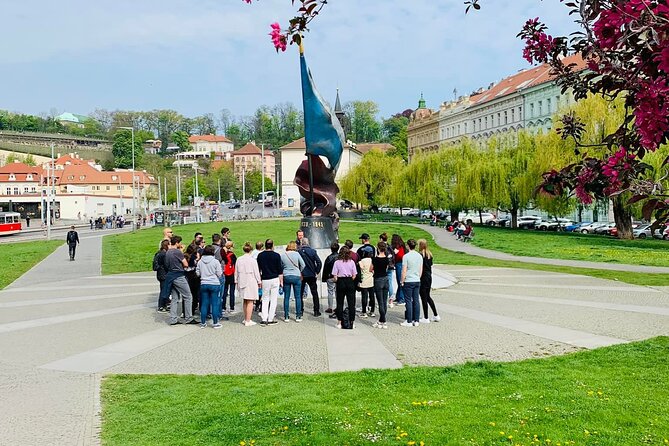
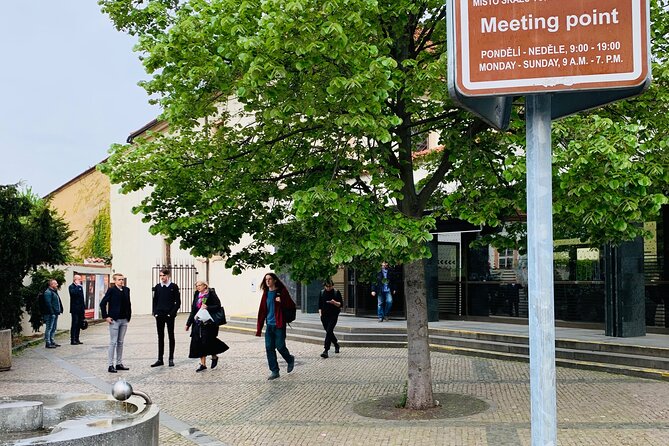
The meeting point is Metrocafe Klárov, at Klárov 51 in Malá Strana. The first stop takes about 20 minutes and introduces two monuments: the Memorial to the Second Resistance and the Winged Lion Memorial.
This is a useful opening because the guide starts before the Second World War. You learn how Czechoslovakia gained independence after the First World War, then why it became one of the first countries occupied by Hitler. The discussion also covers the fate of Czechoslovak soldiers during the war.
That background helps explain the complicated position of the country. Czechoslovakia was not simply a place where the war happened from a distance. Its independence, military forces, resistance networks, and relationship with neighboring powers all shaped what followed.
The stop is outdoors and does not require an admission ticket. Klárov is near public transportation, so getting to the beginning should be straightforward. Arrive ready to walk, since the route soon crosses into Prague’s historic center.
Pinkas Synagogue and the fate of Czech Jews
At Pinkas Synagogue, the guide spends about 15 minutes discussing Czech Jewish communities during Nazi rule. You learn how many people managed to emigrate and what happened to those who could not.
This is one of the most important stops because it gives the war a local face. The subject is tragic, but the short talk fits the pace of the walk. You are not given a separate museum visit here, so your experience depends on the guide’s explanation and the time available.
I would pay close attention to the distinction between emigration and survival. The tour does not treat the Jewish story as a footnote to military events. It places the fate of Jewish families at the center of the occupation story, where it belongs.
The stop also breaks up the walk with a quiet, serious moment. Prague’s old streets can make the past feel distant. A place connected to the Jewish community gives the subject more weight.
Old Town Square and the Prague Uprising
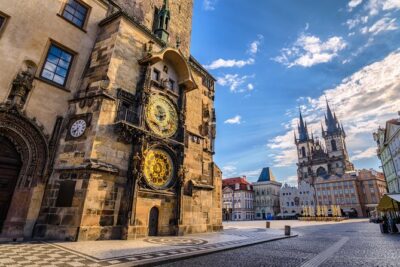
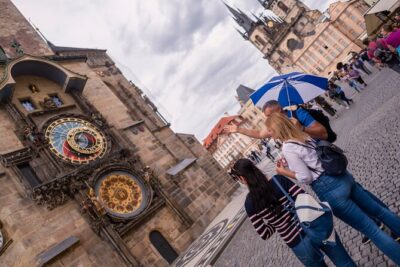
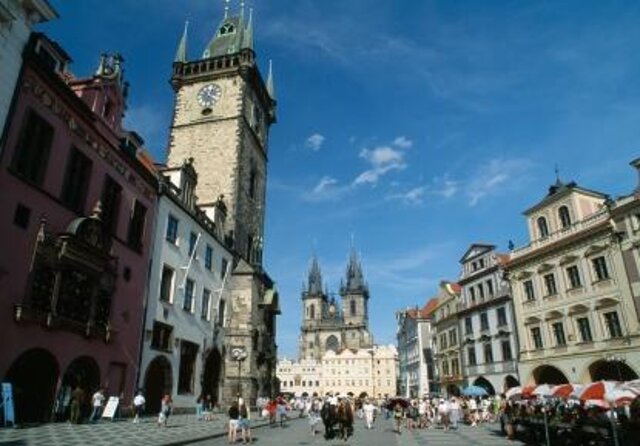
At Staroměstské náměstí, beside the Old Town Hall, the guide explains the Prague Uprising and the final stage of the Second World War. This stop lasts about 20 minutes.
The value here is the connection between battlefield events and political change. The end of Nazi rule did not restore the prewar political order. Instead, the upheaval of liberation helped create conditions for Communist power in Czechoslovakia.
You will probably find this section especially useful if your knowledge of the war ends with Germany’s surrender. The tour asks what happened next, which is the right question for understanding Prague’s later history.
Old Town Square can be crowded and noisy, so staying close to the guide matters. A larger group may make it harder to hear. One person reported a group of 24 despite expecting no more than eight, so if a small group is important to you, confirm the expected size before booking.
Same country, a completely different kind of day:
- Prague: 50-Minute Sightseeing Evening Cruise
★ 4.2 · 33,780 reviews - Prague: Medieval Dinner with Unlimited Drinks
★ 4.4 · 19,847 reviews - Prague: Skip-the-line Castle Ticket and Optional AudioGuide
★ 4.3 · 11,121 reviews - Prague: Castle Tour with Local Guide and Entry Ticket
★ 4.6 · 10,422 reviews
Wenceslas Square, 1968, and Jan Palach
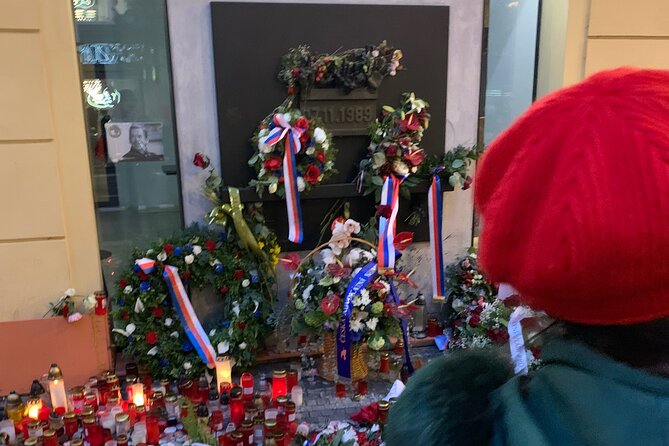
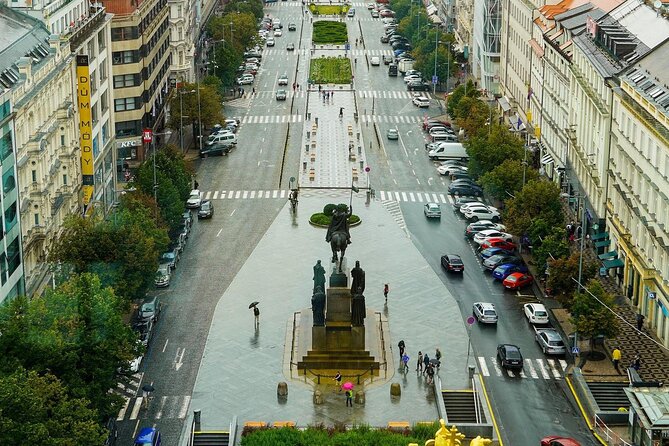
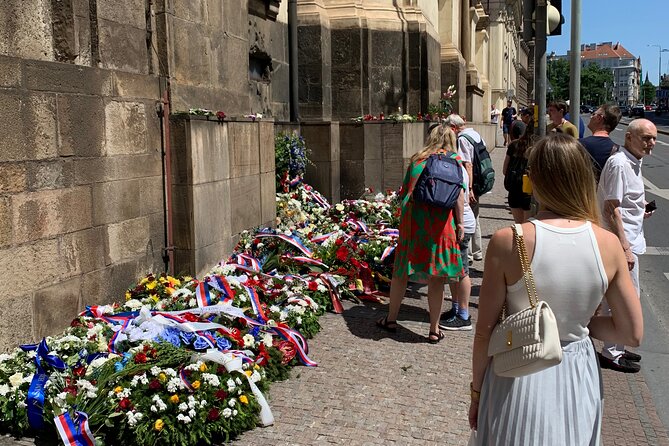
Wenceslas Square is the next major stop, with about 20 minutes devoted to what happened after Communism began. The guide explains the Warsaw Pact invasion of Czechoslovakia in 1968 and identifies the place connected with Jan Palach’s self-immolation.
This is where the tour shifts from occupation and war to resistance under a Communist government. The events of 1968 show that Communist rule was not a single unchanging block. Reform, public hope, and military force collided in the streets.
Jan Palach’s story adds a personal and difficult dimension. The guide does not just discuss policy or armies. You learn about an individual protest that became a powerful symbol of opposition.
Wenceslas Square is also one of Prague’s main public spaces, so the setting helps. Demonstrations, political speeches, and national events have long used this broad square. You can better understand why it mattered during moments of crisis.
Communist art at the Kafka head
At OC Quadrio, the guide points out the Rotating Head of Kafka and talks about art during Communism. The stop lasts about 15 minutes.
This is a shorter, lighter break after the serious discussion at Wenceslas Square, but it has a clear purpose. Art can show how people responded to official rules, censorship, ideology, and public space. The Kafka sculpture gives the guide a modern visual reference while discussing the role of art under Communist rule.
Do not expect a full art tour. The point is to add another way of looking at the period. You get a brief explanation rather than an extended visit or indoor gallery program.
The location also provides a natural pause in the walking route. The tour keeps moving, but the changes in subject help prevent three hours of political history from becoming one long block of names and dates.
Národní třída and the Velvet Revolution
At Národní třída, you see the hands reaching from a wall and learn about the Velvet Revolution and the fall of Communism. The talk lasts about 15 minutes.
This is one of the clearest links between a physical place and a political turning point. The guide explains how opposition grew and how Communist rule ended without the kind of prolonged armed conflict seen elsewhere.
The stop should appeal to anyone interested in the human side of political change. The tour has already covered war, occupation, and military intervention. Here, the focus turns to public action and the collapse of a system that had seemed firmly established.
The short walk between stops also lets you see how close these chapters are in the modern city. Prague’s cafés, shops, offices, and tram routes occupy spaces that once carried enormous political tension.
The National Theatre and Vaclav Havel
At the National Theatre, the guide spends about 10 minutes introducing Vaclav Havel and explaining his role during the Velvet Revolution. Havel later became the first president of Czechoslovakia after the fall of Communism.
This stop gives the political story a central figure. Havel was not presented simply as a president from a later chapter. His role during the Velvet Revolution helps explain how dissident voices became part of the new government.
The National Theatre is a fitting place for this discussion because culture and politics often overlapped during Communist rule. The tour has already touched on art at the Kafka head, and this stop develops that idea through Havel’s public role.
Ten minutes is enough for an introduction, not a biography. If Havel is your main interest, you will want to treat this as a starting point rather than a complete study of his life.
Dancing House and the Valentine’s Day bombing
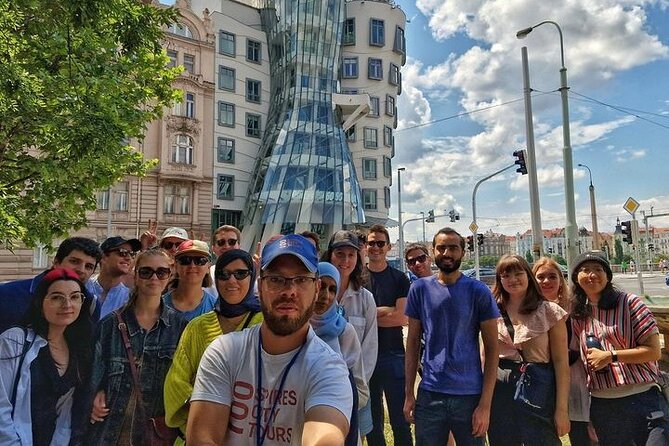
The walk continues to the Dancing House, where the guide shows you the building and tells the story of the Valentine’s Day bombing. This stop lasts about 10 minutes.
It is an unexpected addition to a tour centered on the Second World War and Communism. The Dancing House itself is associated with Prague’s later architectural identity, while the bombing story adds a reminder that the city’s difficult history did not end in 1989.
This section is brief, but it gives the route some visual variety. You are no longer looking only at memorials, squares, or historic churches. The guide uses a modern landmark to widen the discussion beyond the central timeline.
The final stop is close by, so the route then turns toward the cathedral and its underground memorial.
Operation Anthropoid and the cathedral crypt
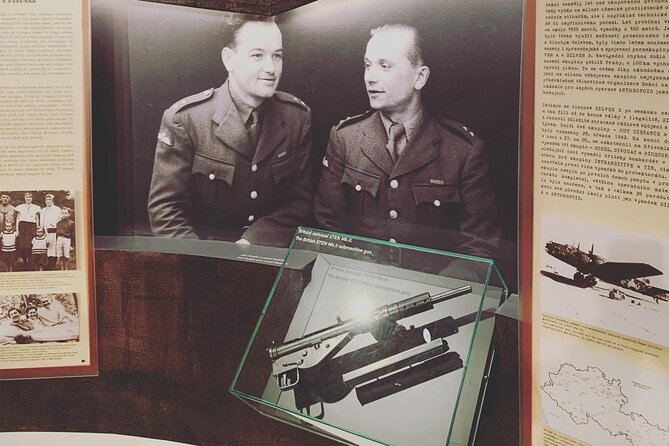
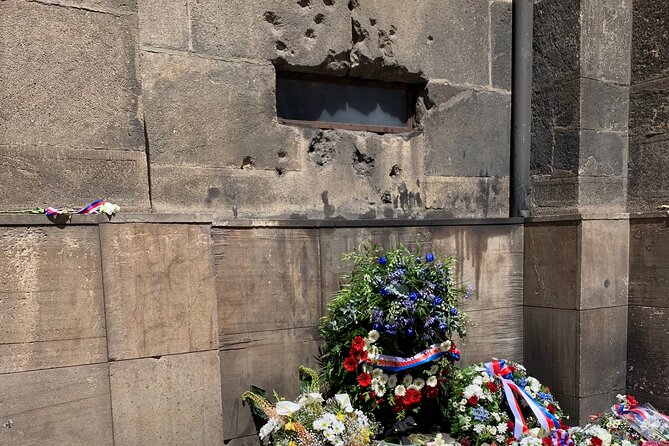
The tour ends at the Orthodox Cathedral of Saints Cyril and Methodius on Resslova Street. The guide spends about 20 minutes explaining Operation Anthropoid, described as the most important achievement of the Czechoslovak resistance during the Second World War.
You also receive entry to the Museum of Anthropoid Operation. The tour ends in the crypt, which served as the hiding place for the soldiers involved in the operation. That makes the final stop more than a quick look at a monument. You enter the actual memorial space connected with the resistance story.
For me, this is the strongest reason to choose this particular route. The earlier stops build the political and wartime background, then the crypt gives the story a physical ending. You can see where the resistance fighters hid and consider the danger in a place that is smaller and more intimate than Prague’s grand public squares.
Animals are not allowed inside the war memorial, though service animals are allowed on the tour generally. The crypt is near Charles Square and about a one-minute walk from the Dancing House, which makes it easy to continue sightseeing afterward.
The walking conditions and group question
The route lasts about three hours and covers roughly 5 kilometers. You need moderate physical fitness, and the experience is not recommended if you have mobility problems.
This is a city walk rather than a hop-on, hop-off outing. You will move between monuments, squares, streets, and the cathedral, with stops for explanation. Wear comfortable shoes and expect to remain on your feet for much of the time.
The activity is described as a private tour where only your group participates, but one account reports joining a group of 24 and being disappointed because a smaller maximum had been expected. That inconsistency is worth checking before you pay. A large group can make street crossings, questions, and hearing the guide more difficult.
The strongest guide reports describe excellent management of larger groups and very clear storytelling. Still, if you want a quiet, discussion-heavy experience, ask about group size in advance.
How much value does the $3.60 price offer?
At $3.60 per person, the upfront cost is unusually low for a three-hour guided walk that includes museum entry. The tip-based structure gives you flexibility, but it also means the listed price should not be treated as the final cost.
The value depends on the guide. A strong guide can make the chronology easy to follow, explain difficult political choices without flattening them, and connect each stop to the next. Kamil is praised for passion and personal context, while Vaclav is praised for clarity, pacing, and storytelling. Katerina and Katarina are also noted for making the material accessible and interesting.
One useful sign is that a person who appreciated the experience chose to pay more than for similar-length tours because the tour felt worth it. You should make the same calculation after the walk. If the guide gives you three useful hours, handles the group well, and brings the historical events to life, a generous tip is fair.
The tour has an overall rating of 4.8 from 47 reviews, with 96 percent of people recommending it. Those figures suggest a strong record, but they do not remove the practical concerns about walking distance and group size.
Who will get the most from this tour?
This tour suits you if you want:
- A focused introduction to Prague’s modern political history
- A walking route that covers both the Second World War and the Cold War
- Clear explanations rather than a museum-heavy schedule
- A guide who can connect dates to people and places
- The chance to enter the Anthropoid crypt
- A useful alternative to Prague’s standard castle and Old Town sightseeing
It is especially good for World War II and Cold War history buffs, but you do not need specialist knowledge. The guide builds the story from the creation of Czechoslovakia and moves forward in order.
You may want another type of outing if you dislike long walks, need frequent seating, or want a small, guaranteed group. The route has several short talks, but it remains an active three-hour walk through central Prague.
Booking, cancellation, and practical details
You receive confirmation when you book. The tour is offered in English, uses a mobile ticket, and begins at Metrocafe Klárov. It ends at the cathedral crypt on Resslova Street.
Free cancellation is available up to 24 hours before the start time for a full refund. Changes or cancellations made less than 24 hours before the start time are not accepted for a refund. The operator also requires a minimum number of people, so a departure could be canceled if that number is not reached.
The tour is near public transportation. Service animals are allowed, but animals are not allowed inside the war memorial at the end. Since the final stop is underground and the route includes about 5 kilometers of walking, people with mobility concerns should consider a shorter or more accessible option.
Should you book the Second World War and Communism tour?
Book it if you want Prague’s recent past explained as one connected story, not as isolated events. The best feature is the final visit to the Anthropoid crypt, but the tour earns that finale by first explaining occupation, Jewish persecution, the Prague Uprising, Communist rule, 1968, Jan Palach, and the Velvet Revolution.
I would book this as an early or middle-day activity during a Prague stay, especially if the castle and Old Town have already given you the familiar postcard view. Go in with comfortable shoes, keep an open mind about the tip, and confirm the group size if that matters to you.
Skip it if 5 kilometers on foot sounds tiring or if you want a small group guaranteed in writing. For everyone else, the low upfront price, included memorial entry, and strong guide record make this a practical way to understand the Prague you cannot learn from architecture alone.
FAQ
How long does the tour last?
The tour lasts approximately three hours.
Where does the tour begin?
It begins at Metrocafe Klárov, Klárov 51, 118 00 Praha 1-Malá Strana, Prague.
Where does the tour end?
It ends in the crypt of the Orthodox Cathedral of Saints Cyril and Methodius at Resslova 9a, Prague. The crypt was the hiding place of soldiers from Operation Anthropoid.
Is entry to the Anthropoid museum included?
Yes. Entry to the Museum of Anthropoid Operation is included.
What language is the tour offered in?
The tour is offered in English with an in-person certified guide.
Can I cancel for a full refund?
Yes, if you cancel at least 24 hours before the experience start time. Cancellations made less than 24 hours in advance are not refunded.
Just added around Prague
- WWII and Communism History in Prague’s Old Town Private Tour★ 5.0 · 4 reviews
- Prague: Historical Walking Tour with Focus on World War 2★ 4.3 · 12 reviews
- World War II 4WD Tour from Prague with Lunch★ 4.4 · 3 reviews
- Ultimate Unlimited Beer Pong with Czech Beer★ 4.6 · 5 reviews
- Walking tour of Prague in French : Nové Město★ 4.9 · 16 reviews
- Walking tour of Prague in french: Old Town & Charles Bridge★ 4.9 · 62 reviews
- Prague Sightseeing Tour with Lunch★ 5.0 · 5 reviews
- Prague: Modern Private Spa with Jacuzzi and Sauna★ 4.8 · 62 reviews
3-Hour Experiences, compared.
3-Hour Walking Tour of Old Town & Prague Castle
Read our review →
3-Hour Old Town and Prague Castle Tour in German
Read our review →
Prague 3-hour Afternoon Walking Tour including Prague Castle
Read our review →