
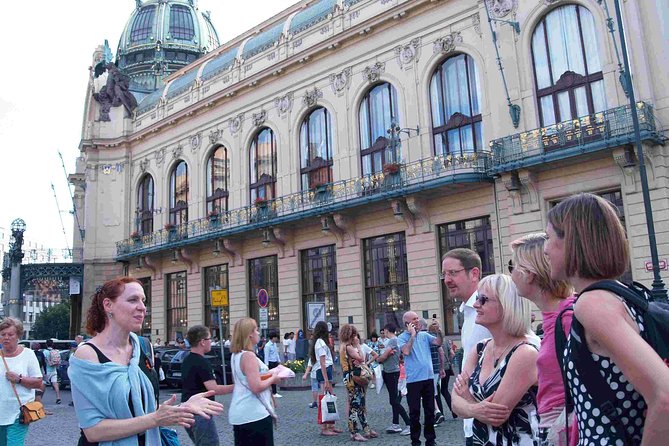
Reviewed · PRAGUE ART NOUVEAU AND CUBISM TOURS
Prague Art Nouveau and Cubism Walking Tour
Prague’s early 20th-century buildings are more than pretty façades. On this three-hour walk, you’ll see how Czech artists turned gingko leaves, crystal shapes, pyramids, curved lettering, and grand interiors into a visual language of national pride and modern life. The route also shows why Prague became one of Europe’s major centers for Cubism.
I like the small group of eight and the way the guide can respond to your interests. I also like the mix of famous buildings and less obvious interiors, including hotel lobbies, a bank, a train station, and the Lucerna arcade. The main consideration is price: at $126.71 per person, this costs more than a standard city walk, so it makes the most sense if architecture and serious local context matter to you.
Key points at a glance
- Prague’s rare Cubist buildings: See the House of the Black Madonna and the Czechoslovak Legion Bank, two key examples of the city’s angular style.
- Art Nouveau interiors: Look inside Obecni Dum, Café Imperial, Prague Main Train Station, and Lucerna.
- A historian-led walk: Guides such as Vadim, Vadim, Bonita, Betty, and Matous connect design with politics, technology, war, and Czech identity.
- A maximum of eight people: The small format allows questions and some tailoring around your interests and walking pace.
- A useful first-day introduction: The tour helps you recognize details you might otherwise pass without noticing during the rest of your stay.
- Easy central finish: The walk ends at Café Louvre on Národní Street, near restaurants and other central sights.
Why Prague is ideal for Art Nouveau and Cubism
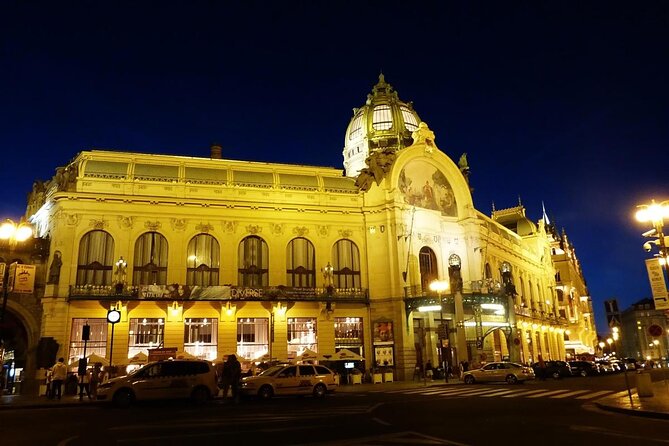
Prague is unusually rewarding for anyone who likes buildings. Medieval towers and Baroque churches get most of the attention, but the city center also contains a remarkable concentration of Art Nouveau and Cubist work from the years around 1900 and just after.
Art Nouveau favors flowing lines, plant forms, elaborate lamps, decorative lettering, and carefully planned interiors. Look up and you may notice gingko leaves worked into a façade or a curve repeated in windows, railings, and signs. The style drew on Eastern art and other international influences, then took on a distinct Czech character.
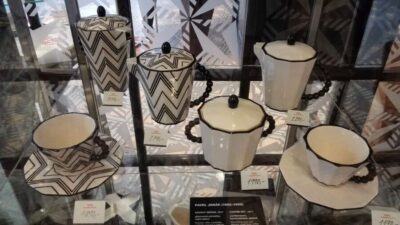
Cubism is harder to spot at first. Instead of soft curves, it breaks forms into sharp planes, pyramids, and crystal-like shapes. Prague became one of the few places where Cubism moved beyond painting and sculpture into whole buildings, furniture, cafés, and household design.
That is the real value of this walk. You are not simply ticking off attractive buildings. You are learning a visual code, then using it for the rest of your time in Prague.
More Prague Art Nouveau and Cubism Tours in Prague:
- Private Prague Art Nouveau and Cubism Walking Tour
★ 5.0 · 30 reviews - Prague Art Nouveau and Cubism Walking Tour
★ 5.0 · 29 reviews - Prague: Private Cubism & Art Nouveau Walking Tour
★ 5.0 · 15 reviews
Starting at Ovocný trh with a historian guide
The tour begins at Ovocný trh 19 in Staré Město, a central meeting point that is easy to reach by public transportation. The listed start time is 10:00 a.m., and morning or afternoon departures are offered in the tour details, so check the time attached to your booking.
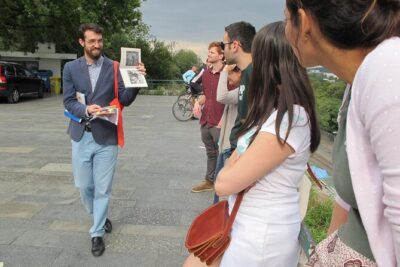
The guide is a historian rather than only a route leader. That distinction matters here. The buildings make more sense when you hear about the Czech National Revival, the growth of the city, changing social ambitions, and the effect of European wars on Prague.
Guide assignments vary. Named guides in the tour material include Vadim, Vadim, Bonita, Betty, and Matous. The strongest praise centers on guides who explain clearly, invite questions, and adjust the route or emphasis to the group. One guide even used a tram to reach a farther area when the group wanted to walk more and see additional examples.
Wear comfortable shoes. The tour lasts about three hours, takes place on foot, and moves through central streets and public spaces. If rain is in the forecast, bring a waterproof layer. The walk can continue in wet weather, but some of the best details are overhead, so an umbrella may get in the way.
House of the Black Madonna and Obecni Dum
The first stop is the House of the Black Madonna, one of Prague’s most famous Cubist buildings. Its design turns an ordinary commercial structure into a study in angles and geometric rhythm. The name comes from the black Madonna sculpture set into the building, but the real lesson is the unusual shape of the structure itself.
You’ll have about 10 minutes here. That is enough for an introduction and exterior viewing, though not enough for a long museum visit. The stop works best as a starting point because it gives you a clear contrast to the softer Art Nouveau buildings coming next.
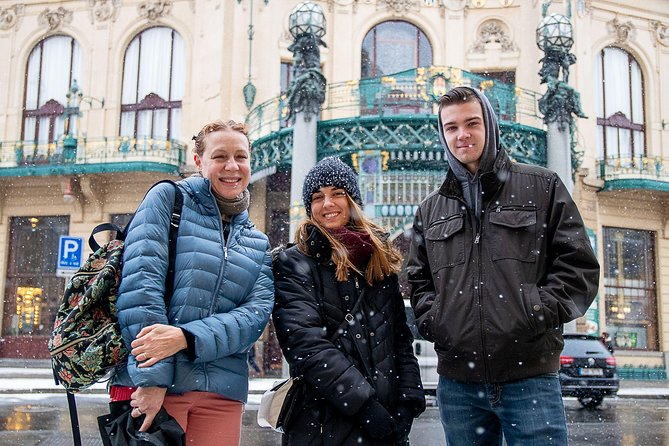
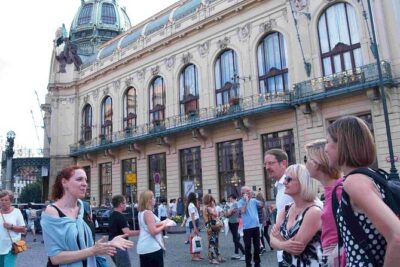
Obecni Dum, or the Municipal House, receives about 15 minutes. This is one of Prague’s essential Art Nouveau landmarks, with decorative stonework, mosaics, lamps, murals, and flowing ornamental detail. Your guide points out how the style works as a complete environment, not just a pattern pasted onto a wall.
The building also helps explain the period’s confidence. Its technology was advanced for its time, with central heating, ventilation, drinking water systems, hydraulic elevators, steam-powered laundry, and an intercom system. Those details are easy to miss when you are focused only on the grand exterior, but they show how decoration and modern engineering developed side by side.
Admission to the listed stops is free, which keeps the tour focused on interpretation rather than ticket queues. Still, 15 minutes at Obecni Dum is an introduction, not a full interior visit. If you want more time there, plan to return on your own.
K+K Hotel Central and Café Imperial
The K+K Hotel Central is identified as Prague’s first Art Nouveau building and gets roughly 10 minutes. A hotel may not sound like a major sight, but it is useful here because it shows how the style entered everyday urban life. Art Nouveau was not limited to palaces. Hotels, shops, cafés, and apartment buildings all used it to signal comfort, modernity, and taste.
If you are staying at the K+K, this stop has extra value. One participant returned afterward to look at the hotel with fresh eyes. That is one of the best signs that the tour teaches you how to see, rather than simply telling you what to photograph.
Café Imperial is a quick five-minute stop. Its Art Nouveau interior is the point, not a scheduled meal. Food and drinks are not included, so do not assume you will sit down for coffee during the tour.
The short stop lets you see the decorative character of a traditional Prague café while keeping the route moving. If the café appeals to you, you can return later for a meal or drink. Several stops on the route also work well as independent places to eat because the interiors are part of the experience.
A few more Prague trips to weigh up
- Prague: 3-Hour Walking Tour of Old Town & Prague Castle
★ 4.7 · 5,696 reviews - Prague: Ghost Walking Tour Where Legends Come To Life
★ 4.4 · 5,253 reviews - Prague: Jewish Quarter Walking Tour with Admission Tickets
★ 4.7 · 3,729 reviews - Prague Guided Walking Tour and Cruise with Authentic Czech Lunch
★ 5.0 · 3,627 reviews
The Legion Bank and the political meaning of Cubism
The Czechoslovak Legion Bank gives you another strong Cubist example, but with a different story. Its architecture and interior are tied to the Czechoslovak Legion of the First World War. That connection brings politics and national identity into the walk.
Here, the guide can show how architecture carried messages. A building was not merely a shelter or office. It could express ideas about the new state, military service, Czech identity, and the desire to break from older imperial traditions.
The stop lasts about 10 minutes. As with the other exterior visits, you should expect explanation and selected views rather than a long private tour of every room. The small group helps because your guide can answer questions without trying to project over a crowd.
This is also where the tour moves beyond a simple Art Nouveau versus Cubism lesson. You begin to see design as part of a larger argument about who the Czechs were and what kind of future they wanted.
Prague Main Train Station and technology in public life
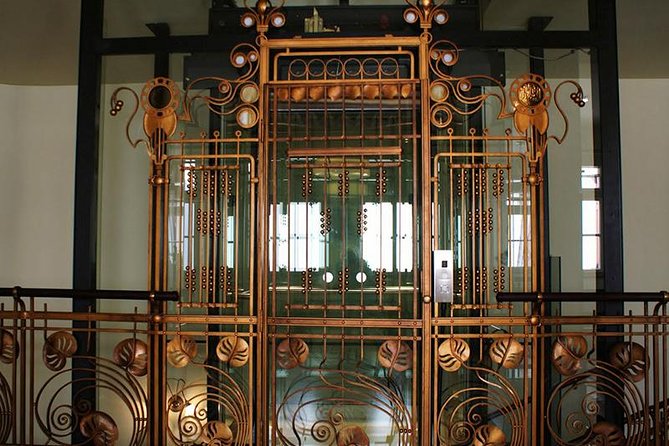
Prague Main Train Station is an especially useful stop because transport buildings reveal how quickly cities were changing. The station has a magnificent Art Nouveau dome and an interior that rewards a pause, even if you are mainly catching a train.
The tour allows about 10 minutes here. A practical bonus is that a guide has helped participants understand how to navigate the station. That can be useful if you arrive in Prague by rail or plan to take a train later.
The station also reinforces the tour’s technology theme. Art Nouveau was not just about flowers and graceful lines. It appeared during a period of new transport, improved public services, electric lighting, modern heating, and faster communication.
You may find this stop less intimate than a café or hotel because stations are working public spaces. People are moving through them, and the noise can interrupt an explanation. Even so, the dome and interior give you a strong example of how public infrastructure could be designed with real artistic ambition.
Wenceslas Square, Art Deco, and the city’s changing mood
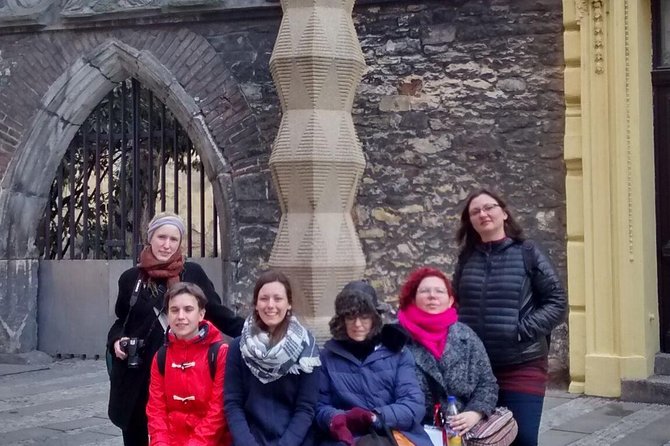
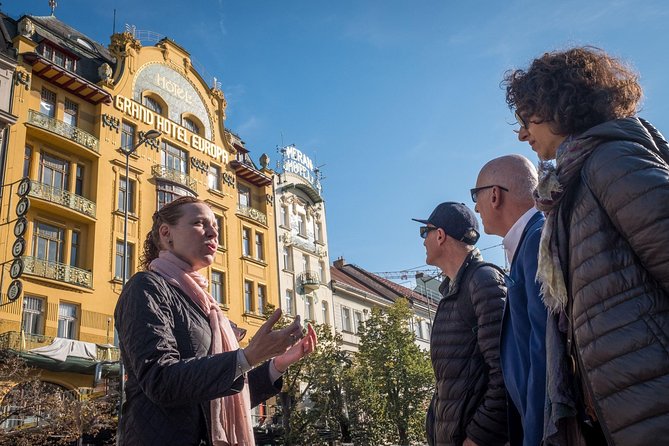
Wenceslas Square receives about 15 minutes and broadens the discussion to include Art Deco. The square is a long urban corridor rather than a single building, so your guide can compare several façades and show how Art Nouveau gradually gave way to sharper, cleaner Art Deco forms.
This is also a natural place to discuss Prague’s modern political life. The square has witnessed major moments in Czech history, and its buildings reflect the city’s changing ambitions and tastes. The tour links architecture with the wars and political shifts that altered Prague’s direction.
You might find the square crowded or noisy, especially at busy times. That is part of its character, but it can make a long explanation harder to hear. Stay close to the guide and ask for clarification when needed.
I particularly like this portion for people who do not think of themselves as architecture fans. You can watch a style change across a large public space, then connect that change to the way society itself was changing.
Lucerna and the upside-down Wenceslas sculpture
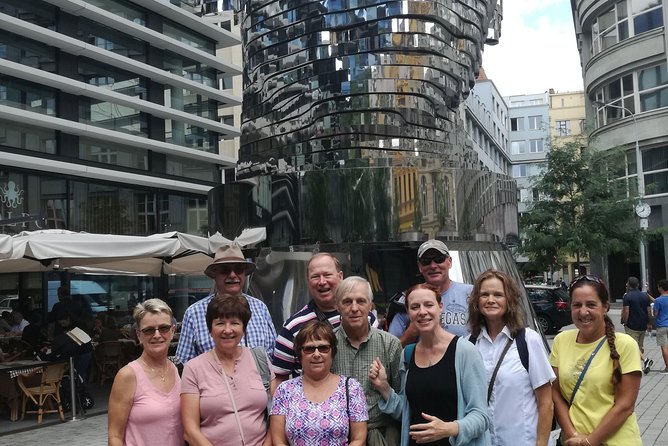
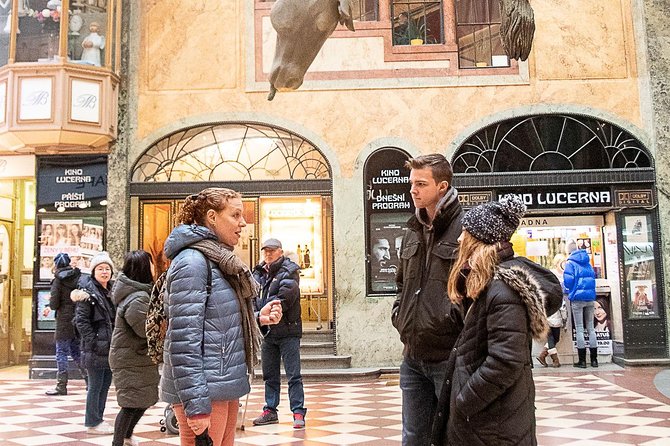
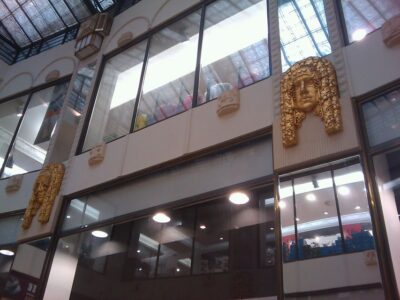
Lucerna Music Bar is scheduled for about 10 minutes. The tour uses the beautiful Art Nouveau arcade and interior to evoke the optimism and experimental spirit of turn-of-the-century Prague. Its decorative details offer a more intimate contrast to the grand scale of Obecni Dum and the open space of Wenceslas Square.
The stop also brings in avant-garde movements. You see how entertainment, design, music, and new social habits were part of the same modern mood. The name Music Bar may suggest a nightlife stop, but this portion is about the arcade and its architecture, not an evening event.
Nearby, you’ll see David Cerny’s upside-down statue of King Wenceslas riding a dead horse. It is a contemporary work with a deliberately sharp sense of humor. The guide places its symbolism in the context of Czech history and the Czech National Revival.
This final artistic turn is useful. After several hours of looking at buildings from around 1900, you get a modern sculpture that asks you to think about how Prague handles its past. It also reminds you that the city’s architectural conversation did not end with Art Nouveau or Cubism.
Ending at Café Louvre on Národní Street
The tour ends at Café Louvre, Národní 22, in New Town. The café opened in 1902 and is associated with figures such as Franz Kafka, Albert Einstein, and T. G. Masaryk. You are not promised a meal or a reserved table, but the location makes a natural place to continue the afternoon.
The finish is practical. You are close to restaurants, public transportation, and other central attractions. If you have an appetite after three hours of walking, Café Louvre itself may be worth considering, though food and drinks are your responsibility.
Because the route ends in the center, you can also use the last stop as a launching point for more sightseeing. By then, you should have a better eye for decorative lettering, geometric façades, and interior details across Prague.
What $126.71 buys you
At $126.71 per person, this is a premium walking tour. You are not paying for entrance tickets, lunch, or transport. The price mainly covers a specialist guide, a small group, and a carefully linked route through several major and lesser-known examples.
That makes the value depend on how you travel. If you only want a quick introduction to Prague’s famous sights, a cheaper general city walk may suit you better. If you want to understand why a building looks the way it does, and how design connects to Czech politics and society, the higher fee is easier to justify.
The small group is important. With no more than eight people, the guide can take questions, adjust the pace, and sometimes tailor the route toward Cubism, Art Deco, interiors, or broader history. One participant who first felt the cost was high later considered the extra expense worthwhile because the experience was more personal than a large group tour.
There are also group discounts, a mobile ticket, and free cancellation up to 24 hours before the start time. Cancellations made less than 24 hours ahead are not refunded, and late changes are not accepted.
Who should book this Prague architecture walk
I would choose this tour early in a Prague visit if you like architecture, design, history, politics, or cafés with old interiors. The lessons carry over to the rest of the city, so later walks become more rewarding.
It also suits families with a broad age range. The route has enough visual variety for younger adults, while the historical stories give older participants plenty to think about. Most people can take part, but you should be comfortable walking for about three hours.
You do not need a background in art. The best guides explain how to spot the difference between Art Nouveau, Cubism, and Art Deco in plain terms. Guides such as Vadim and Bonita are praised for linking buildings to people and events, while Matous is noted for bringing the Art Nouveau period to life with enthusiasm.
The tour is less suitable if you want extensive time inside each building, a meal, or a relaxed café visit during the route. The schedule gives most stops 5 to 15 minutes, so take notes, ask questions, and return later to the places that catch your eye.
Should you book it?
Book this Prague Art Nouveau and Cubism Walking Tour if you want the city to make more sense, not just look attractive. You’ll see landmark buildings, but the real payoff is learning to recognize the shapes, symbols, materials, and social ideas behind them.
I would especially recommend it for a first or second day in Prague, when the guide’s explanations can sharpen everything you see afterward. Skip it if $126.71 feels too steep for a walking tour or if your main goal is a broad survey of Prague’s medieval sights. For design-minded visitors, curious history buffs, and anyone who enjoys finding meaning in ordinary streets, this is a strong use of three hours.
FAQ
Where does the Prague Art Nouveau and Cubism Walking Tour start?
The meeting point is Ovocný trh 19 in Staré Město, Prague 1, Czechia.
Where does the tour end?
The walk ends at Café Louvre, Národní 22, Prague 1, New Town.
What time does the tour start?
The listed start time is 10:00 a.m. The experience also offers a choice of morning or afternoon departure, so check the departure selected at booking.
How long does the tour last?
The walking tour lasts approximately three hours.
How many people can join the group?
The group has a maximum of eight travelers.
Is food or drink included?
No. Food and drinks are not included unless specifically stated. Hotel pickup and drop-off are also not included.
Can I cancel for a refund?
Yes. You can cancel at least 24 hours before the local start time for a full refund. Cancellations or changes made less than 24 hours before the start are not accepted for a refund.
Just added around Prague
- WWII and Communism History in Prague’s Old Town Private Tour★ 5.0 · 4 reviews
- Prague: Historical Walking Tour with Focus on World War 2★ 4.3 · 12 reviews
- World War II 4WD Tour from Prague with Lunch★ 4.4 · 3 reviews
- Ultimate Unlimited Beer Pong with Czech Beer★ 4.6 · 5 reviews
- Walking tour of Prague in French : Nové Město★ 4.9 · 16 reviews
- Walking tour of Prague in french: Old Town & Charles Bridge★ 4.9 · 62 reviews
- Prague Sightseeing Tour with Lunch★ 5.0 · 5 reviews
- Prague: Modern Private Spa with Jacuzzi and Sauna★ 4.8 · 62 reviews
Prague Art Nouveau and Cubism Tours, compared.
Browse the lists this tour appears in