
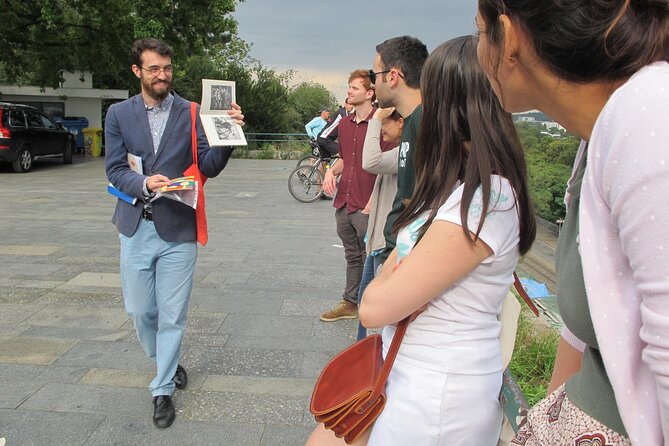
Reviewed · PRAGUE ART NOUVEAU AND CUBISM TOURS
Private Prague Art Nouveau and Cubism Walking Tour
Prague’s medieval center gets most of the attention, but this private walk shifts your eyes to the city’s bold early-20th-century designs. You’ll trace Art Nouveau curves, floral details, and Czech Cubist angles from the House of the Black Madonna to Lucerna Arcade. I especially like the private format and the way the route connects architecture with Czech cultural hopes at the turn of the century.
I also like the stops that let you look inside, including Café Imperial, the Legion Bank, and Prague Main Station. Guides such as Robert Wesley and Bonita bring extra context through history, art, and personal stories. The main drawback is simple: three hours on foot is a lot, and the route may not suit anyone with limited mobility.
Key points before you book
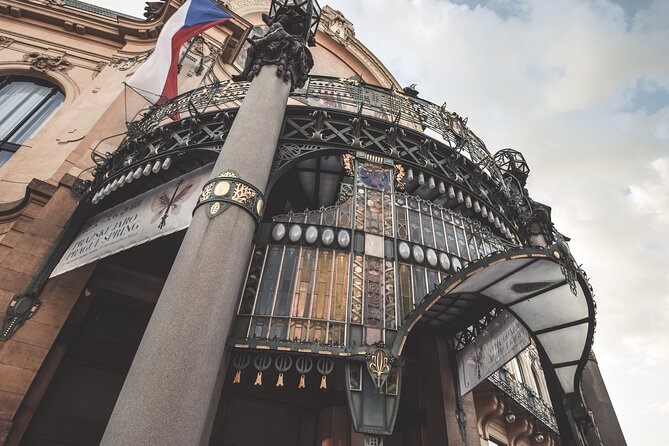
- A private three-hour route: Your group alone takes part, with room to ask questions and set the pace within the planned walk.
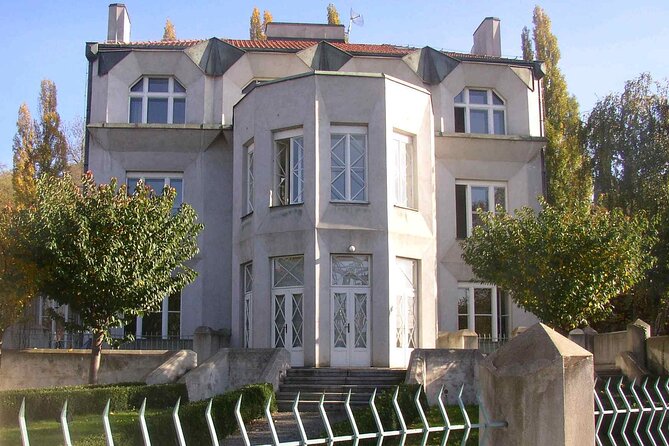
- Two striking styles: See the geometric House of the Black Madonna alongside Prague’s ornate Art Nouveau buildings.
- Useful indoor stops: Café Imperial, Prague Main Station, Lucerna Arcade, and other interiors give you more than a façade-only tour.
- A strong Czech context: The walk links architecture to national revival, Czech optimism, and the country’s place in modern Europe.
- Guides with character: Robert Wesley and Bonita have led this experience, bringing history, culture, art, and architecture together.
- Good value for a group: At $396.46 for up to 10 people, the price makes more sense when shared by several people.
Why Prague’s modern architecture deserves three hours
Prague can feel like an open-air museum of Gothic towers, Baroque churches, and Renaissance courtyards. That is part of its charm, but it can also make the city’s newer architecture easy to miss. This tour focuses on the years when Prague was looking ahead, not only back.
Art Nouveau arrived with flowing lines, plant forms, decorative lettering, colored glass, and carefully designed interiors. The style could make a doorway, lamp, sign, or ceiling feel like part of a larger work of art. You’ll look for details such as gingko biloba leaves, a clue to the style’s interest in Asian design.
Cubism takes a different route. Instead of soft curves, it uses sharp geometry and broken planes. Prague’s version is especially interesting because the city adapted Cubist ideas for buildings, furniture, and interior design rather than treating them as a passing fashion.
I like this pairing because you do not spend three hours looking at one style in isolation. The contrast helps you see both more clearly. One building may seem decorative and graceful, while the next feels angular and almost architectural in its furniture and façade.
The historical setting matters, too. At the turn of the 20th century, Czech society was expressing confidence in its own culture and its place in Europe. New buildings, banks, cafés, hotels, and public spaces reflected that mood. Your guide’s job is not just to name the architect or style, but to explain why these buildings mattered to the people using them.
More Prague Art Nouveau and Cubism Tours in Prague:
- Prague Art Nouveau and Cubism Walking Tour
★ 5.0 · 77 reviews - Prague Art Nouveau and Cubism Walking Tour
★ 5.0 · 29 reviews - Prague: Private Cubism & Art Nouveau Walking Tour
★ 5.0 · 15 reviews
Starting at the House of the Black Madonna
The usual meeting point is Grand Cafe Orient at Ovocný trh 19 in Prague 1, unless hotel pickup has been arranged. Meet your guide 15 minutes before the start. This is also a sensible place to begin because the House of the Black Madonna is nearby.
The House of the Black Madonna is one of Prague’s clearest examples of Cubist architecture. Its name refers to a statue of a black Madonna on the building, and its design uses strong geometric forms that make it unlike the older buildings around it.
You get about 10 minutes here. That is enough for an introduction and an exterior look, but not enough for a long museum visit. Admission is not included because there is no admission charge for this stop as planned.
I would pay close attention to the way the building fits into a historic part of Prague while still looking sharply modern. This is one of the best early stops because it gives you a visual definition of Cubism before the tour moves into more ornate Art Nouveau work.
Obecni Dum and the city’s public face
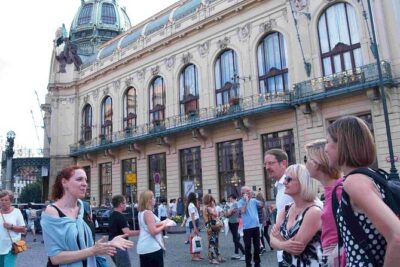
Next comes Obecni Dum, or the Municipal House, one of Prague’s best-known Art Nouveau buildings. You have about 15 minutes here, with time to study the exterior and discuss its role in Czech cultural life.
This is not merely a pretty building covered in decoration. Its design reflects the period’s desire to create a modern Czech public setting. Look for the unified treatment of sculpture, ornament, windows, and lettering. Art Nouveau works best when all these parts feel planned together, and Obecni Dum makes that idea easy to understand.
The stop is free, but the tour does not promise a full interior visit here. That matters if you want to see every major room. You are coming for the architectural reading and historical setting rather than an extended museum tour.
K+K Hotel Central and Café Imperial
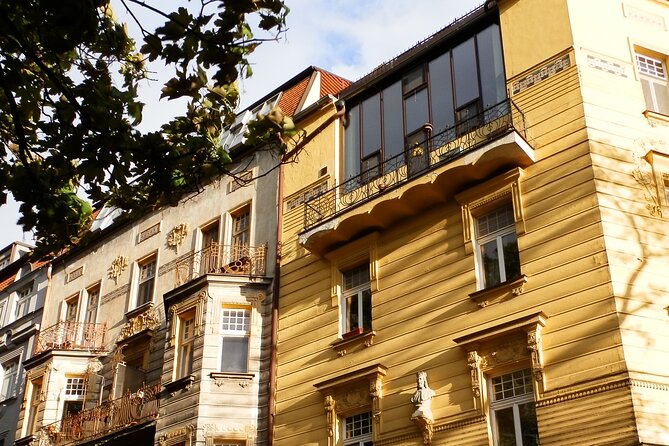
The K+K Hotel Central Prague is introduced as Prague’s first Art Nouveau building. You have about 10 minutes to examine it and discuss the early arrival of the style in the city.
A hotel is a useful example because Art Nouveau was not limited to palaces or government buildings. It shaped places where people stayed, ate, met, and conducted business. The K+K Hotel Central helps you picture Prague as a city eager to take part in current European design.
Café Imperial follows, with about five minutes devoted to its Art Nouveau interior. This is a short stop, so you should expect a quick look rather than time for a meal. Food and drinks are not included, but the café’s interior gives the route a human scale. Instead of thinking only about architects and national pride, you can imagine how these decorative spaces felt in daily use.
I like this part of the walk because the buildings are not treated as frozen monuments. Hotels and cafés show how a new visual style entered ordinary city life. You might find yourself noticing lamps, tilework, lettering, and curved forms in places you would otherwise pass without a second look.
A few more Prague trips to weigh up
- Prague: 3-Hour Walking Tour of Old Town & Prague Castle
★ 4.7 · 5,696 reviews - Prague: Ghost Walking Tour Where Legends Come To Life
★ 4.4 · 5,253 reviews - Prague: Jewish Quarter Walking Tour with Admission Tickets
★ 4.7 · 3,729 reviews - Prague Guided Walking Tour and Cruise with Authentic Czech Lunch
★ 5.0 · 3,627 reviews
The Czechoslovak Legion Bank’s sharper Cubist mood
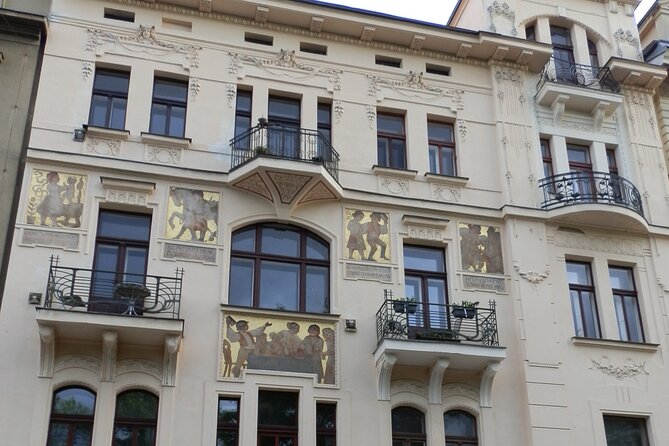
The Czechoslovak Legion Bank offers another Cubist contrast. The building has distinctive Cubist architecture, and its interior is connected to the Czechoslovak Legion of the First World War. The planned stop lasts about 10 minutes.
This is where architecture and national identity come together most directly. A bank is a place of money and public trust, but this one also carries a military and civic story. The Cubist design gives it a forceful, structured appearance that fits the period’s interest in new forms.
The interior is an important part of the stop. Many city walks point out façades and move on. Here, you have a chance to consider how Cubist ideas worked indoors as well as outside. The amount of time is brief, so listen closely when your guide points out the key features.
For me, the value lies in seeing that Czech Cubism was not just a visual trick. It could serve serious public buildings and connect modern design with a national story.
Prague Main Station’s unexpected Art Nouveau interior
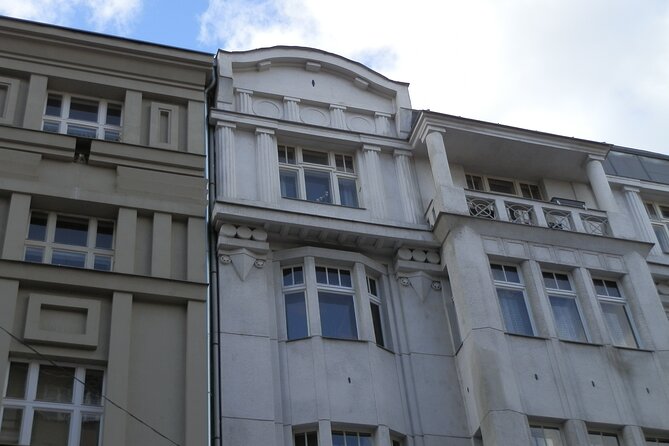
Prague Main Station is one of the route’s most useful surprises. From the outside, a train station can seem like a place to hurry through. Inside, you’ll see a magnificent Art Nouveau dome, with about 15 minutes set aside for the stop.
Rail stations were symbols of connection and progress. Their design told people that the city was part of a changing Europe. The dome and interior decoration make the station more than a transport hub, and your guide can help you read those choices in their period setting.
This stop also gives the tour a practical urban setting. You are not visiting architecture in a quiet gallery. You are seeing a working station that still serves its original public purpose. That can make the design feel more immediate.
The timing is enough to appreciate the main interior features, but you should not expect a long station tour. Keep an eye on your belongings in any busy transport area, and stay with the group as the tour continues.
Wenceslas Square and the changing city center
The walk then reaches Wenceslas Square, with about 15 minutes for Art Nouveau and Art Deco architecture. The square is broad and urban, so this portion helps you understand how individual buildings form a larger city setting.
Here, the conversation moves beyond one strict style. Art Nouveau and Art Deco overlap in the story of Prague’s changing center, but they do not look the same. Art Nouveau favors organic movement and decorative detail, while Art Deco tends toward stronger geometry and a cleaner sense of order.
I find this kind of comparison more useful than memorizing dates. You can look at the façades in front of you and begin to sort the visual clues for yourself. The square also shows how the city’s early-20th-century buildings were made for commerce, public life, and movement.
Do not expect an extended history of every building around Wenceslas Square. The stop works best as a guided discussion of the styles and the square’s place in modern Prague.
Lucerna Arcade and a family link to Czech public life
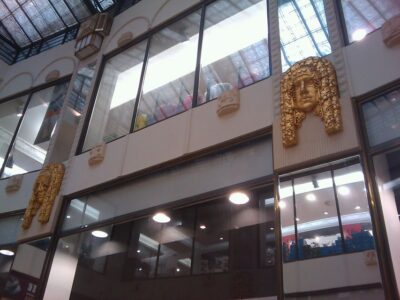
Lucerna Arcade is one of the most appealing stops for anyone who enjoys interiors. You have about 10 minutes to view its Art Nouveau design, including the arcade’s decorative public spaces.
Arcades can be easy to overlook because they are passages rather than major monuments. Yet they show how Art Nouveau reached shops, entertainment venues, and places where people gathered. The enclosed setting also lets you notice details that are harder to read on a large exterior.
The route includes the Lucerna Bar, once owned by Vaclav Havel’s family. That connection adds a modern Czech political and cultural layer to the architecture. You are not only looking at decorative forms. You are also considering the people and institutions that used these spaces.
This is a good point to ask questions. On a private tour, you are not tied to a large group’s agenda, so you can spend a little more time on the details that catch your eye, provided the timing allows.
The upside-down King Wenceslas statue
The final listed stop is the upside-down statue of King Wenceslas riding a dead horse. This contemporary sculpture brings the tour into the present and changes the tone from historical architecture to political symbolism.
The guide discusses the statue in relation to Czech history and the Czech National Revival. That context is important because the work is meant to be read, not simply photographed. Its humor and provocation make more sense when connected to the country’s ideas about national identity, authority, and public memory.
I like ending here because it keeps the tour from becoming a parade of old façades. Prague’s design story did not stop with Art Nouveau or Cubism. The statue asks you to think about how Czechs continue to use art in public places to question their own past.
The route ends in Prague, Czechia. Exact walking time between the stops is not specified, but the full experience lasts about three hours and involves substantial walking.
A private guide makes the history easier to follow
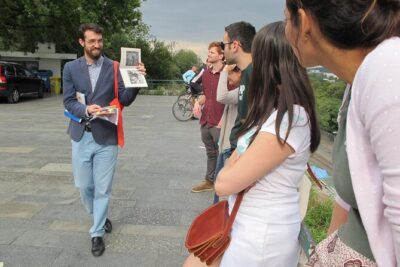
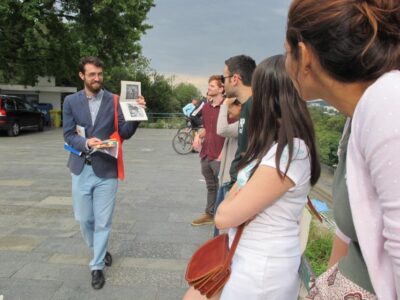
The tour includes a historian guide, and the private format is its strongest practical feature. Your group can ask about a building, a symbol, or a piece of Czech history without waiting for a large group to move on.
Robert Wesley has led the walk and brings an unusual personal background. He is Czech-born with a Nigerian father, and his stories connect the buildings with his own experience as well as Prague’s past. That kind of personal thread can make a three-hour architecture walk feel less like a lecture.
Bonita has also led the experience, bringing together art, architecture, culture, and history. If you want a guide who can connect visual details with broader ideas, this is the sort of approach to expect.
The exact guide is not guaranteed, so you should not book solely for one person. Still, the experience is clearly designed around interpretation rather than a bare list of addresses. The five-star rating from 30 reviews and a 100 percent recommendation rate suggest strong satisfaction, though you should still match the tour to your walking ability and interests.
Price, timing, and practical value
The cost is $396.46 per group of up to 10 people. That is expensive for one person, but the calculation changes quickly when shared. A full group of 10 pays about $39.65 per person, while a group of four pays about $99.12 per person.
The price includes the historian guide. Food, drinks, and hotel pickup and drop-off are not included unless pickup has been arranged separately. You have a choice of morning or afternoon departure, and you should give your preferred time when booking.
The tour is offered in English and uses a mobile ticket. It is near public transportation, with the default meeting point at Grand Cafe Orient. Pickup may be offered, but the stated inclusions do not include hotel transfer, so confirm this when arranging your booking.
Free cancellation is available if you cancel at least 24 hours before the start time. Cancellations or changes made later are not accepted for a refund.
Who will get the most from this walk
I would choose this tour if you have already seen Prague’s major medieval sights and want a different side of the city. It also works well early in your stay because it trains you to notice Art Nouveau and Cubist details during the rest of your visit.
The private format suits couples, families, and small groups who enjoy asking questions. It is especially useful if some people in your party care about architecture while others prefer social history, cafés, public buildings, or modern Czech culture.
You should be ready to walk for three hours. One detailed account describes the route as unsuitable for people with mobility limitations, while the general information says most people can participate. I would treat that as a warning to discuss your needs before booking, rather than assuming the route can be adapted.
The tour is less suitable if you want long interior visits, free time for meals, or a slow photography walk. Several stops last only five to 15 minutes, so the guide has to keep the group moving.
Should you book the Prague Art Nouveau and Cubism tour?
Book it if you want Prague’s modern side explained by a private historian rather than found by chance. The best parts are the clear contrast between Cubist and Art Nouveau design, the unusual interiors at Prague Main Station and Lucerna Arcade, and the connection between architecture and Czech identity.
I would be more cautious if you dislike walking or want a tour with lots of unstructured time. For a group of several people, the $396.46 fee can be fair value, especially when you appreciate personal guiding and focused discussion. For a solo visitor, it is a major splurge.
For architecture fans, design students, curious first-time visitors, and small groups sharing the cost, this is a strong choice. Bring comfortable shoes, arrive 15 minutes early, and look up from street level. Prague’s 20th-century story is written in its lamps, signs, domes, angles, and arcades.
FAQ
How long is the Prague Art Nouveau and Cubism walking tour?
The tour lasts approximately three hours.
How much does the private tour cost?
The listed price is $396.46 per group, for up to 10 people.
Is the tour private?
Yes. Only your group participates in the activity.
What language is the tour offered in?
The tour is offered in English.
Where does the tour start?
Unless hotel pickup has been arranged, meet at Grand Cafe Orient, Ovocný trh 19, Prague 1, 15 minutes before the start time.
Is hotel pickup included?
Hotel pickup may be offered if arranged, but hotel pickup and drop-off are not included in the stated inclusions.
Are food and drinks included?
No. Food and drinks are not included unless specifically stated.
Can I cancel for a full refund?
Yes, if you cancel at least 24 hours before the experience’s start time. Cancellations or changes made less than 24 hours before the start time are not accepted for a refund.
Just added around Prague
- WWII and Communism History in Prague’s Old Town Private Tour★ 5.0 · 4 reviews
- Prague: Historical Walking Tour with Focus on World War 2★ 4.3 · 12 reviews
- World War II 4WD Tour from Prague with Lunch★ 4.4 · 3 reviews
- Ultimate Unlimited Beer Pong with Czech Beer★ 4.6 · 5 reviews
- Walking tour of Prague in French : Nové Město★ 4.9 · 16 reviews
- Walking tour of Prague in french: Old Town & Charles Bridge★ 4.9 · 62 reviews
- Prague Sightseeing Tour with Lunch★ 5.0 · 5 reviews
- Prague: Modern Private Spa with Jacuzzi and Sauna★ 4.8 · 62 reviews
Prague Art Nouveau and Cubism Tours, compared.
Browse the lists this tour appears in